Microlocs and Me: Journey to Hair Freedom

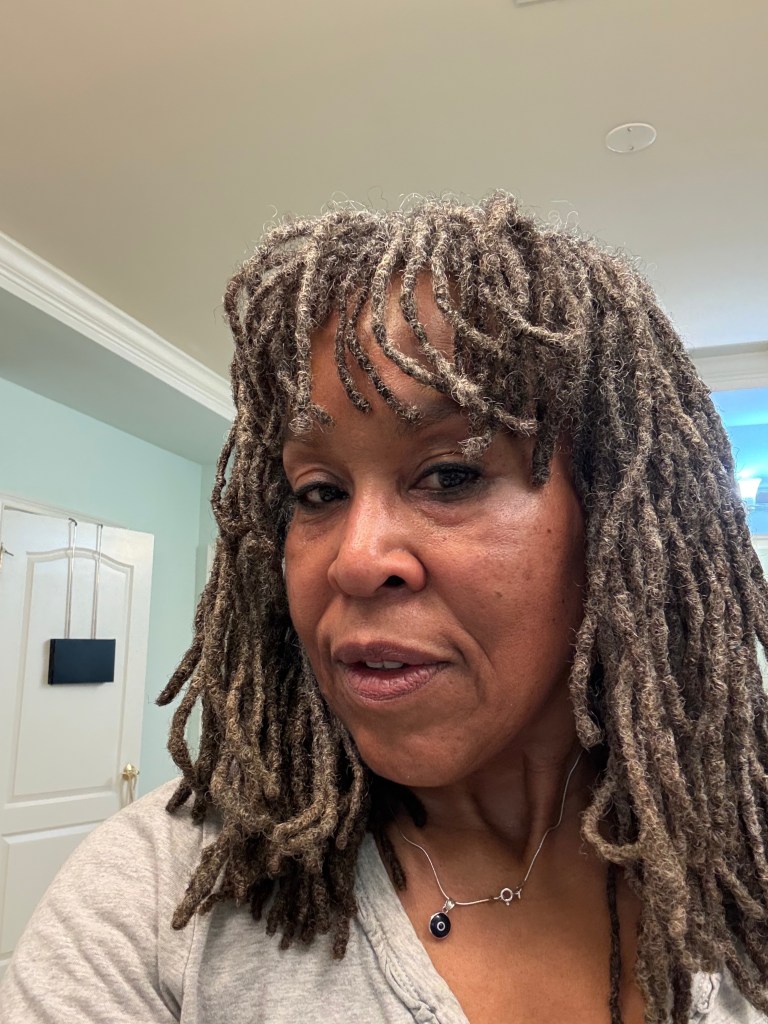
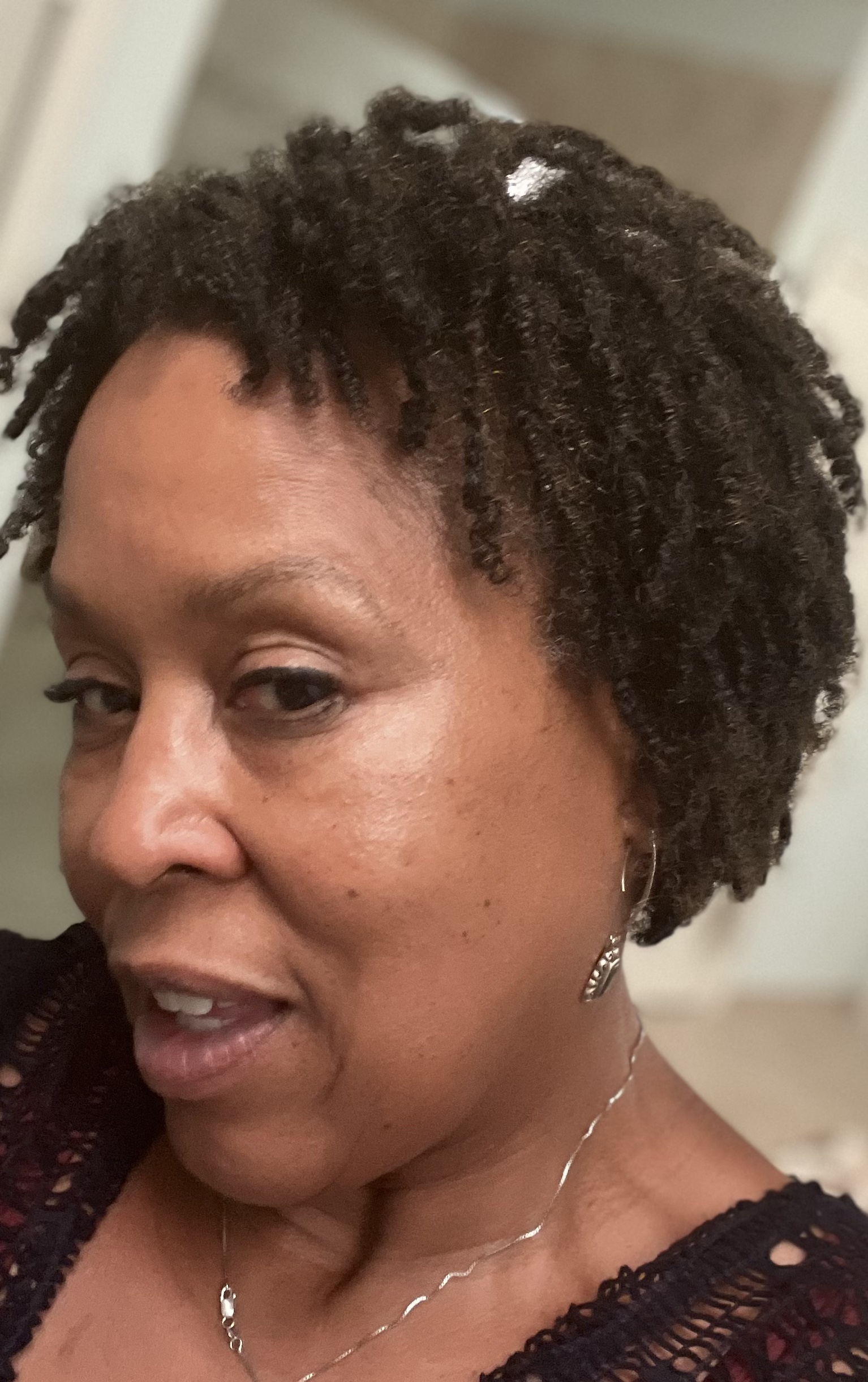
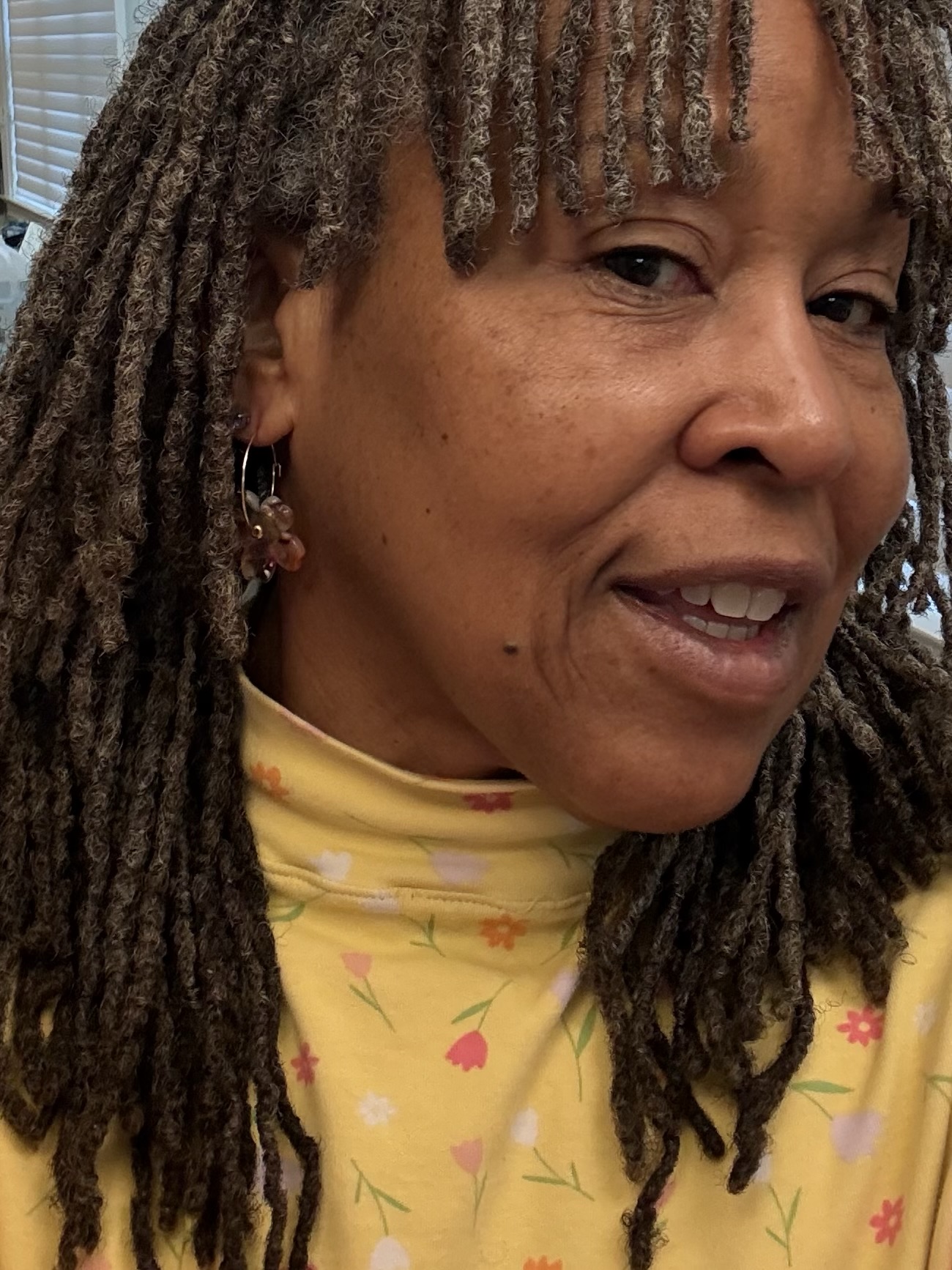
New earrings and a headband jazz up every day loc styling.

It is March and Spring cannot be far behind. To convince myself Spring is truly coming, I took a trip to the Philadelphia Flower Show with my sister and a girlfriend. Just so happened we planned our trip for March 2nd which coincidentally marked three years and eleven months on my loc journey.

Welcome to the Blog! My name is Bettye. I am a DIY microloc wearer, designer, installer and maintenance maven. I have 208 microlocs. I have low porosity hair. This blog is my opportunity to discuss experiments and experience with my microlocs, so I can be a force (…well, a presence) in influencing a wider acceptance of microlocs.

Over the past month, I have cut my locs, interlocked my roots and learned to make peace with a two headed dragon. If any of this interests you, please read on.

Before I forget, the earrings I am wearing in the intro are lovely white lilies of molded plastic. The stamens or centers are raw brass. Both pieces move with you as you go through your day. These earrings are from Studio Bladel, a vendor at the Flower Show. Studio Bladel also sells on Etsy. These earrings are called “Nora”. I would have bought them even if they did not bear my sweet little niece’s name. They are playful, lightweight and do not fight with my locs. I am not receiving anything for my endorsement. I just love the earrings.

Cutting Locs: Always an Adventure

One of the reasons I started my loc journey is length retention. I wanted my hair to grow longer and it has done that! In my opinion, my locs are long at their current length. In the back, my locs lay on and between my shoulder blades. They are about 3-4 inches away from touching the bottom strap of my bra. In the front, my locs rest 3-4 inches below my collar bones. My locs are proof length retention is attainable if you have faith in the locking process and follow basic maintenance methods.

With increased length comes new responsibility. Simply put, long locs can overwhelm the wearer with voluminous hair. Locs can grow to cover or hide your face. They can cause you to constantly wipe your locs from your face, eyes or mouth. Or, like a couple of locs at my temples, they can grow so long and heavy individual locs begin to thin. If and when this happens, trimming your locs is a consideration.

Last year in January (2025), I cut the locs around my face into layers. In the blog I mentioned the two Youtube video content makers I relied on to trim my locs: Lillian Okibe and Pauline from En Toi Beauty. Briefly, I sectioned my hair from one ear to the other and trimmed rows of locs across my forehead at an angle. I trimmed only the locs in front of my ears. The layers remained thoughout the year. For maintenance, I simply trimmed the locs in my bangs.

By February 2026, the layers in the bangs were all even and the side layers had slowly lengthened by 4 to 6 inches (if we assume a half inch of hair growth each month.) When I see pictures of myself looking shaggy I know it’s time for a trim.

This year I looked at videos about cutting longer straight hair for inspiration. The “butterfly cut” tutorial that results in a hair style similar to the Farrah Fawcett feathered cut of the 70s caught my attention. There were some similarities. Again, I sectioned the front of my head by drawing a line from ear to ear. My line was/ is in front of my ears. Next, the tutorial tells you to put a rubber band around the hair ( in my case, locs) in front of your nose and cut off the hair on the farside of the rubber band.

I’m always a little skeptical about following videos blindly. So, I put decorative metal cuffs on my locs just on the farside of the elastic band and then removed the band so I could see just how much of my locs would be cut off.

It was more than I felt comfortable cutting. So, I replaced the elastic band and brought it down another inch. I moved the metal loc cuffs down and then I cut those locs on the farside of the metal bands. I removed the metal cuffs and finger combed my locs in place. They looked pretty good. I trimmed a little more off one or two locs. Then I put my scissors away.

When you cut your locs there’s a good chance hair strands will curl out of the now open end of your locs. Dampen the cut ends and palm wrap or finger roll each cut loc. You may need to snip off a bit more of the loc if it lengthens while rolling the loc end between your fingers. If so, cut the loc end at an angle.

The next day, I finger combed my locs to see if the newly cut locs were lying in the right place. Only two required slight additional trimming.

Have you attempted to trim your locs? Were you intimidated by fear of cutting your locs too short? If you were brave and trimmed your locs, were there any steps you wish you had done differently? What style were you trying to do?
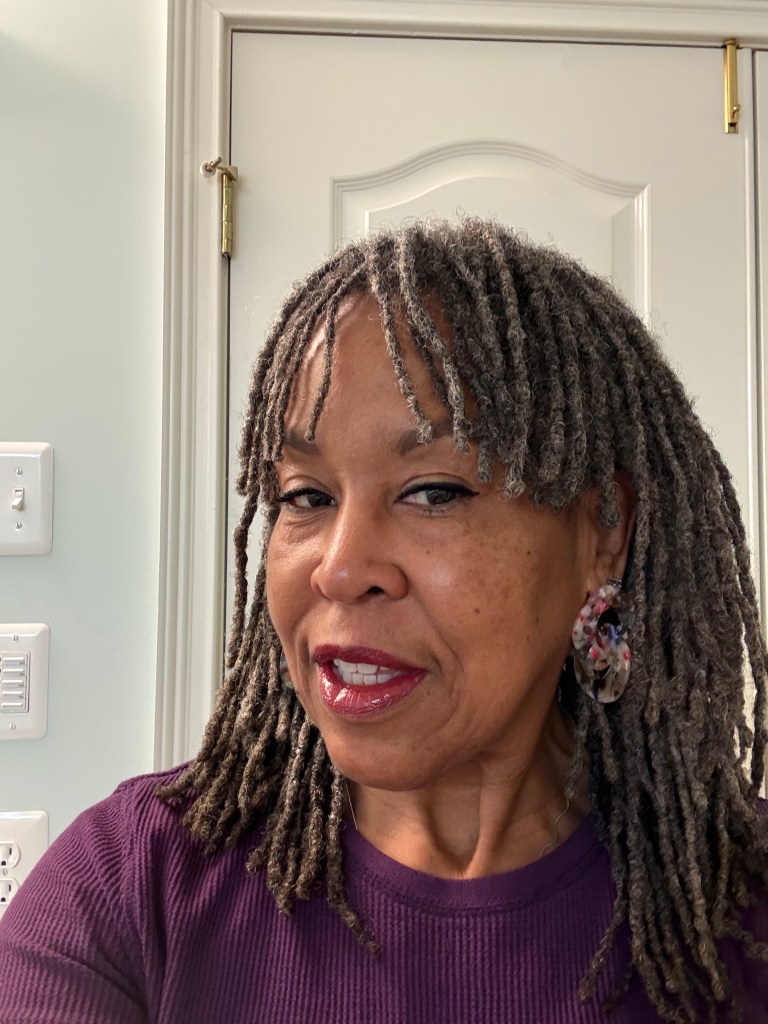
I am happy with the fresh cut.

I chose microlocs as my loc style because I wanted a variety of styling options. But, did I really? I wear my hair down and on my shoulders pretty much all day everyday. This layered cut makes my locs easier to style. So, even though I can pull my locs into a half up/ half down style, I only do this style in yoga or dance class and occasionally when going out to a big evening event.

If you have locs, have you tried trimming your locs, yet? If you haven’t trimmed your locs, do you think you will? If not, what would make you consider trimming your locs?

This picture gives you a good look at the layers in my locs. You can see I do have the option to wear a side part.

Loc Spray of the Month

This month I am seeking a boost in my mood because it has been cold, foggy and grey for weeks along the Atlantic seaboard. The first boost comes when I remove my bonnet, shake out my locs and spray this combination of distilled water and essential oils. The orange and peppermint essential oils really help lift my spirits.

This blend is called Winter Sunshine:

To 10 ounces of distilled water add

3 drops of Tea Tree Oil,

4 drops of Peppermint Oil,

5 drops of Jasmine essential oil and

7 drops of Orange or Sweet Orange essential oil.

You might not notice but I have reduced the amount of essential oils I use. I noticed a fine build up or film on my locs when I used essential oils in higher amounts. Every one’s hair is different. You will have to experiment to see how much essential oils your locs like. My hair is low porosity so the essential oils sit on my hair strands after the water evaporates even though I take extra steps in my routine to encourage the cuticles on my hair shaft to open. This month I will experiment with doing something more.

Specifically, I have a steam cap I used infrequently last year. I am going to incorporate a steam treatment 1-2 times a week into my routine and analyze the results. That sounds like a pretty good experiment before my locs turn 4.

Rosewater vs Essential Oils

When I use commercial rosewater on my locs, the first day my locs feel hydrated. But, when I use rosewater on two consecutive days, I feel a buildup that is invisible but still present. I have found that when I spray with my essential oil blend the day after spraying my locs with rosewater this keeps the film from occurring.

However, my essential oils mix will also leave a similar invisible film after a few days. I took this as a sign to reduce the amount of essential oils I use per spray bottle. While this has worked, I want to encourage the cuticles on my hair shafts to open and absorb as much moisture as is healthy. I will report back my observations on steam heat on microlocs. If you have had some experience using a steamer on your locs, please share in the comments.

I will be back next month with my 4 year locaversary issue. Meanwhile, may God bless and keep you!

Bettye

Loc Journey Tips & Insights

February 2026

The holidays came and went. Happy New Year! The temps have been in the freezer around here. Brrrr….. My locs are sitting on my shoulders in all their resplendent glory and will not be ignored.

Welcome to the Blog! My name is Bettye. I have been sporting my microlocs (aka locs) since April 2, 2022. So, I have been on my loc journey for 3 years and 10 months. During this time I have learned a few things and I have tried several things about which I had no real clue. Somehow, my locs are thriving and healthy. Let’s talk about what’s been going on.

Why Locs?

I came to the decision to loc my hair out of frustration. I had been a loose natural hair devotee for about 10 years when I started my loc journey. I had a shelf full of hair products and yet I was often surprised by the way my hair would turn out after I shampooed and styled it.

The biggest surprise was that after 10 years I did not have natural hair on my shoulders. I really longed for length retention and that eluded me for 10 years. Sometimes it takes a while before we open our eyes to the truth. The truth is my natural loose hair was never going to grow to the length I desired.

This was an eye opener because I had let go of my relaxed hair which seldom grew beyond my neck, in order to have long natural hair. When I realized that neither permed hair nor loose natural hair was going to provide me with length retention, I was ready to try locking my hair. Maybe you have been coming to this same realization. If so, I hope this is your sign that it’s time to try something different.

Microlocs?

When I established my locs, I started with 212 – 215 two strand twists. The number is not set in stone. I had read that to start microlocs you needed at least 200 locs. Last year, I read that microlocs started at a count of 250 locs. I was surprised, a little, but not to the point where I wanted to start over with smaller locs. Currently, I have 208 locs on 4B and mostly 4C hair. I am so happy with the number of locs I have I would not consider changing the count to be classified as a microloc wearer by that author.

In my mind, I have 208 fat microlocs and I am very pleased with my locs. If you are thinking about establishing microlocs, I say Go for it! You do not need 300, 400, 500 or more locs to enjoy the benefits of microlocs.

Semi Freeform Experiment Ended

While I love, love, love my microlocs, I have had a questionable relationship with interlocking since the first week of my loc journey. Like many I started my locs with two strand twists and within the first week of establishing my locs, I interlocked the roots of my twists. I had planned to use the interlock method because I didn’t see anyone else with microlocs retwisting their locs. Also, I couldn’t see how retwisting or palm rolling was going to hold all of those locs in place.

I bought 2 different type of interlocking tools from Amazon and a “crochet” tool which is used to grab and mat hair within a loc. All the advice suggested your hair should be wet when you interlock. So, that’s what I did. I think the wet hair was the biggest problem. Fortunately, my hair shrunk so much after my first shampoo I had short, small locs to work with. Short, little locs were easier to interlock. Keeping them separated as I made my 2 and 3 point rotations still required a slight learning curve.

At first, I interlocked whenever I had new growth as thick or long as the width of my middle finger. Every time I interlocked I saw new length retention and I was ecstatic. Even so, I was worried that the process of interlocking would ultimately lead to thinning locs. I was very worried about the number of strands I would break while making the passes with my locking tool.

Consequently, I decided to try different methods of maintaining my locs. I decided to wait and extend the time between interlocking to 3 and 4 months.

In January of 2026, I interlocked my hair for the first time in four and a half months bringing to an end a period where I only locksmithed my hair in an experiment to see if my locs would become thicker. This experiment both did and did not work as expected. Locksmithing entailed separating my locs, pulling strands of hair embedded in the wrong loc out of that loc and wrapping or braiding the loose strands around the correct loc. More about locksmithing tips below.

With my 4C strands, the locs were matting on their own and they were locking. However, I have a swath of 4B hair that goes grows in a half circle across the center back of my head just below the crown. Some 4B hair is also located around my front perimeter. Please note that I did not realize the extent of my 4B hair until after I had locked my hair…and I had taken care of my hair as a loose natural for almost 10 years.

The 4B locs did not respond well to locksmithing. First, the hair in those locs when retwisted would twist and flatten into curls. These twisted pieces at the roots were thin…and you already know I am afraid of thinning locs.

Knotted Locs

On either side of my face, just below the temples there are 2 locs, one on each side, that looked like they were attached with only strands of hair. I tied knots in them to make the base of the loc the same thickness as the length of the loc. I realize this might sound radical. Keep reading.

In the summer of 2024, I had tried 3 knots in 3 of my locs as an experiment in ways to keep locs thick. This method was promoted heavily by Melissa Blake for use on thinner locs. For me, it was an experiment and I picked the smallest of my locs to try it. Today, I can only find one of the original 3 knots in my locs. Having had that experience, I was comfortable repairing my two temple locs with knots.

Have you ever intentionally tied a knot in your locs? What was the outcome?

One Maintenance Routine

I interlocked the 4B locs in the back to make sure those locs maintained their integrity at the roots. While I was interlocking, I thought about having two maintenance practices for my locs and then discarded that idea. I did not and do not want to have a great variation in the size of my locs. So, for the time being, I am back on Team Interlock for maintaining all of my locs.

Locksmithing

There are some things about locksmithing I do really like. I still have hand in hair syndrome. I love the feel of my locs. Even though I am interlocking again and I plan to interlock regularly…maybe every 6 to 8 weeks, we will see. I like separating my locs daily…or as close to daily as I can. I still separate by individual strands of hair. One at a time. 99% of the time I am able to extricate one strand from the wrong loc without any breakage. Proud of that! Then, I wrap the newly freed strands around the right loc. Sometimes, if there are several strands, I will braid the strands around the right loc. This does hold the strands in place better.

Just wondering, if you have locs already, what types of locksmithing do you use on your locs? Do you locksmith between interlocking sessions? Do you call this attention to your locs by a name other than locksmithing? What do you call it?

Interlock: With or Without Water

The new experiment that arose from this last round of interlocking is the use of water…or rather, the lack of using water. In preparation for this interlocking session, my hair was dry. I sprayed my locs with my daily moisturizing spray. If you have been here before you might remember I spray my locs daily with a combination of distilled water and essential oils.

Occasionally, I will use just distilled water and sometimes I will use rosewater just because I have it. The rosewater spray can only be used once or twice between shampoos because it leaves a buildup if I spray it on consecutive days. However, spraying rose water one day and distilled water with essential oils the next leaves my locs feeling very supple and without any product residue. I highly recommend you try this combination if you’re using rosewater.

Interlocking with relatively dry locs actually worked very well. It seemed as though there were fewer strands of hair broken bringing the loc through itself. I am not sure why this worked so well. I only know that going forward I will start with dry locs and spritz them before interlocking.

Conjoined Locs

The biggest take away from this interlocking session is probably the need to use more clips, take my time and put the tools down when I am getting fatigued. Why? Well, truth be told, I interlocked two small locs together. Again.

I have conjoined locs before and the tip is to Leave It Alone for a couple days then come back and see if you can withdraw the last pass of your loc. Sure, I tried to do this as soon as I had interlocked the two locs together. I waited about a week and tried to separate the two locs again. Sometimes you need a little new growth to give the loc room to pass through. In this case however, the two locs were both 4B locs and as I struggled to separate them I realized at the root they would be better as one loc. Have you ever combined any locs?

Combining Locs

The length of the two locs presented another problem. I have previously combined 2 similar locs by twisting them around each other. There is a slight bulge at the end of the shorter of the two locs that I am still rolling between my fingers to make the loc look smoother. The two cojoined locs were almost the same length and thickness so I didn’t want to cut off either one. My solution: Sew the two locs together. I used black cotton thread and a regular sewing needle. I held the two locs together and ran my needle in and out of both locs pulling every couple of stitches to make certain the locs are sitting close together as one. Basically, I used a running stitch to combine the two locs. Voila! No more two headed dragon!

It’s humbling to be almost 4 years loc’d and still interlocking two locs together. I will recommit to taking my time when interlocking. I will be interlocking because this maintenance works for all of my locs. Just wondering if anyone else occasionally interlocks two locks together by accident?

Despite the hitches, I am ready to roll with the punches because my locs give me a sense of accomplishment. I have brought my hair from a head full of short twists to a head full of luxurious locs.

At almost four years, you might think my locs should be longer. I am happily accepting the length I have. When I walk down the stairs I am surprised to see locs bouncing above my breasts. When I look in my 3 way mirror, I see locs on my back lying on my shoulders. When I go outside, my locs lie against my neck and keep it warm. Friends this is the length retention I was hoping for all those years ago when I first did my big chop. How do your locs surprise you?

Grey Locs

I have no plans to color my locs because as my hair changes from dark brown to grey to platinum, I have all the color play I need going on naturally. Grey locs are gorgeous like all locs and they really elevate your look and style. Just saying.

If you have started your loc journey would you please drop in the comments how long you have been loc’d. How many locs you have and why you decided to lock your hair. I would love to hear it.

Moisturizing Spray Recipe

This month, this is the essential oils combination I am using in my daily spray. Start with 10 ounces of distilled water (this amount is due to the size of my spray bottle).

3 drops of Tea Tree Oil,

7 drops of Peppermint essential oil,

7 drops of Orange essential oil, and

7 drops of Jasmine essential oil.

Tea Tree oil, orange and peppermint essential oils have antibacterial, antiseptic and antifungal properties. Orange essential oil acts as an energizer, fighting fatigue and increasing alertness. The scent is a natural deterrent to ants, spiders and other insects. Peppermint oil acts as an astringent, manages oiliness and soothes itchy skin. It can also increase mental focus and enhance stamina. Jasmine essential oil is antiseptic, antibacterial and antioxidant. It helps fight skin infections, reduce inflammation and is called the “perfume of love”. I have not picked a name for this blend, yet. If you try it, and the fragrance suggests a name to you, please drop the name in the comments. I will mention it in next month’s blog.

I like this combination because while it makes my locs smell wonderful, it will make my hair an inhospitable place for mold, mildew and lice – not that I have a problem with any of these, I just like to stay ahead of any issues. If you try this blend, please let me know what you think.

Until next time, if you are loc’d enjoy your locs, follow your maintenance routine and stay loc’d! If you are still on the fence about locs, what is keeping you from taking the plunge? Really. I want to know. Let’s chat again next month.

Microlocs and Me: A Woman’s Journey to Hair Freedom

Welcome to the blog! My name is Bettye. I established my DIY microlocs on April 2, 2021. I am obsessed with my 209 locs. I believe more women would love their hair and eliminate a lot of unnecessary anguish if they tried locs. This is the whole premise behind this blog. The goal is to make locs more accepted and appreciated as a hairstyle. Let’s get to this month ‘s issues.

As a relatively new loc wearer, perhaps like you, I am tuned into the video tutorials and length updates on YouTube, Instagram and occasionally Tik Tok. I also read other blogs to help me understand what is happening in the world of locs and dreads. A lot of my content is reporting back to you the results of experiments I have made with my locs so you have an idea what to expect and what to try based on my success or failure. Yep. Failure does happen. Fortunately, microlocs are forgiving and many times you can undo a bad experiment. I talk about how to do this too.

UPDATE

Currently, I am tweaking my loc maintenance routine. In August 2025, I interlocked my locs and joined 3 locs together. After 3+ years of interlocking, you have to ask, how did you do that? I was watching a football game on tv and drinking beer. A lack of attention and ability to focus coupled with 3 months of only retwisting my locs put me in a place where it was easy to lock 3 locs together.

What did I do? You can go back and read the excruciating details in last month ‘s blog installment. In short, I stopped the retie. I let my hair grow a week and retraced the last interlock to separate the three locs. I then made 2 locs out of the three. Combining locs is a personal decision that I had vowed was over for me. Yet, the thickness of those two locs had me concerned. I have not decided how long I want my locs to grow. I just know I need a good strong base for my locs regardless of their length. Those two locs are in my 4B section and retwisting instead of interlocking had caused them to thin and flatten.

I’m very fond of my two strand twisted ends. I have long ago cut those ends off my bangs. I regretted it; but, I wanted bangs to be a part of my hairstyle. So, off with the ends! The locs around my face were layered in January 2025. Good bye two strand twisted ends there, as well. The locs in the back however, have grown evenly and not required trimming in three and a half years. My thought process: if it’s not broke, don’t fix it!

The opposite is also true: if it’s broke, try, try, try to fix it. After more than three years I had a whole section of locs that were thin at the roots. This section of locs is where my 4B hair is located. I had been twisting my locs once a month and maybe twice a month to maintain my locs for about 3 months. The 4C strands which form the majority of my hair worked fine with retwisting for loc maintenance. Treating the two types of hair differently for maintenance was only a fleeting thought. I decided to return to interlocking… which was how I interlocked 3 locs together.

NEW MAINTENANCE EXPERIMENT

I decided to take on wrapping new growth around the loc as a maintenance plan. I will also take chunky bits of new growth, divide that into two sections and braid the new growth with the loc. The goal is to allow the loc to fill the section of hair in which it is based. This should allow the loc to grow fuller and fatter. I’m counting on the fuller base to support a long loc – just in case I decide I want locs down to my waist. The cons of this approach are the base of the loc will look very fuzzy for an inch or so. I embrace volume. Now the experiment will give me an idea how long it takes for my hair strands to lock on their own. What an experiment!

It is now November and the holiday season is upon us. I have been living with the new maintenance plan and discovering new things. I feared that shampooing my locs would cause me to lose track of the parts which keep my locs separated and leave me with a head full of uncontrollable new growth. That has not happened. I continue to shampoo my hair once a week. To apply shampoo I continue to use a spray bottle to spray shampoo on my scalp and on the length of my locs. I lather my hair by massaging the scalp with the balls of my fingers. I rinse well. My second shampoo is with a moisturizing or hydrating shampoo which I focus on the length of my locs. I do occasionally add a conditioner especially in the fall and winter. I rinse out the conditioner very well. I squeeze my locs in the shower to remove as much water as possible before wrapping my hair in a microfiber towel. My low porosity locs dry in 2-3 hours.

I do not try to separate my entire head of locs as soon as I remove my towel. I do however separate every loc before my hair dries completely. To separate my locs, I separate individual strands of hair from errantly embedding into the wrong loc. I wrap the adventurous strand around the right loc and keep it moving.

The new growth is nice and thick . I have consequently interlocked my bangs since starting my “new maintenance” routine. Last week I had an evening event. I thought my bangs were standing too high and each loc was standing separate from the group. So, I interlocked the bangs. A few days later I interlocked the locs at my temples because the new growth was growing away from the locs. To do this, I wrapped the new growth around the nearest loc and interlocked them. I will continue to reassess the need to interlock new growth in these areas. The remaining locs, which constitute the majority of my locs, are thriving under the new maintenance routine. Most of the new growth grows into these locs. The 4B locs are also growing well. They are no longer thin and curling at the roots. For that I am thankful!

If you have locs, or if you’re thinking about starting locs, I hope you will take this to heart: you can change your locs by changing your maintenance routine, schedule or habits. This is probably true for all hair but I know it to be true for locs.

Have you noticed changing how you maintain your locs changes their appearance and even the way they feel? Locs really make you pay attention to your hair. What parts of your routine have you changed to make your locs respond and look the way you want?

STRAIGHT HAIR TRENDS

One thing I’m noticing is there seems to be a trend towards straight hair in the black hair community today. I’m not sure if it’s the absence of summer humidity or the many gatherings fostered by the holidays; but, straight hair whether pressed with a hot comb or permed is growing very trendy.

I am compelled to ask if anyone has noticed how straight hair styles are the basis for most loc styles? I am now very spoiled. My locs fall out of my sleeping bonnet in the morning looking a little wild but with a spritz of water and a little manipulation my straight hairstyle is ready for the day. When I wrap my locs around my head the way I once wrapped my permed hair around my head to get a wrapped bob, I get the same swingy look. This satisfies any need I have for straight hair.

WATER AND LOCS

If you know, you know. Water helps your locs expand and shrink up. In essence, water helps your hair lock up. Water also allows your hair to be flexible and pliable. When hydrated your locs are bouncy and squeezable, it’s truly amazing.

Last month I mentioned Dreadlock Kulture a blog hosted by loc wearer Nadia. One of the things she does that I love is she gives recipes for loc hair sprays using water and blends of essential oils. I thought I might try some of my own mixtures and share those I believe are really good. I find the essential oils are really very light; they have beneficial properties that can support hydrating your locs; they add a beautiful fragrance to your locs and do not leave build up on your locs. Tea tree oil especially is good for its antimicrobial properties and it will keep you from having lice in your locs. Lice are contagious bugs that will live in human hair. They are gross. I grew up thinking lice only lived in Caucasian hair because black hair was permed and chemically treated regularly. Since that is not my black hair reality, the concern about lice is very small. Shampooing regularly, in my case weekly, keeps pests away.

Nadia’s hair texture is different than mine. She has 1A hair strands.The amount of essential oils she uses in her recipes leaves a feeling of a light film on my locs. To fix this I reduce the amount of essential oils I use and I get the same benefits. If you try this or any recipe using essential oils, be experimental and observe. You may be able to add more or less depending on your hair.

FLORAL FANTASY – Loc Spray

Start with 10 ounces of distilled water. Add 5 drops of Ylang Ylang, Jasmine and Peppermint essential oils. Add 2-3 drops of tea tree oil. Mix in a spray bottle. Shake before spraying on locs. This mixture should last a week or two. Please let me know what you think.

Best wishes for your loc journey as we go into winter here in the Northern hemisphere. The plan is to publish an update on the new semi free form loc maintenance routine before the end of the year. Hope to see you then.

Microlocs and Me: A Journey to Hair Freedom

Welcome to the Blog! My name is Bettye. I have 209 microlocs and today I am celebrating 3 years and 6 months of being loc’d!

WoW! Had I known at the start I would still be here enjoying and thriving on this journey I might have started a Vlog at the same time. Not because my journey has been free of obstacles but because I did not know how much this journey would mean to me above and beyond a way to style my hair.

It’s been two months since I have blogged. The first thing you might notice is the number of locs has changed. In recognition of having reached this goalpost on my loc journey, and because I did something really stupid in August, I felt it was time for me to count my locs. When I first counted my locs I used small black rubber bands to hold my 3 month old locs in groups of 20. I had 212 locs and I was happy. What happened? I am not sure. bundle each group. This is what I do remember. I combined 4 locs into 2 around my 3 month anniversary. I then started a new loc at the left side of my forehead. I thought the total was 212. In August, I decided to interlock my locs. I had not interlocked my entire head since February even though I had retightened the locs that make up my bangs during that time. I had been maintaining my locs by separating them and rolling or retwisting them. This method was working fine for my 4C hiar. It was not working for my 4 B hair as I was to discover. The 4B locs were thinning at the root. The strands of hair in the locs were compressing and forming a loose curl. I knew from previous experiments that tying a knot in the loc would result in slightly thicker locs from the point of the knot to the root of the loc. But, of the 3 knots I had made in thinner locs in August of 2024, I can still find the knots in those locs more than a year later. So knots were not my first choice to address loc thinning. I decided instead to interlock the thinning locs. I discovered a few things about my hair in the process.

First, the section of my hair that is 4B is confined to an area just below my crown across the back of my head. When I finished interlocking, I noticed this area is shaped like a rainbow across the back of my head. Very interesting. I have had this hair for decades now and never noticed this.

While I was interlocking the thin 4B locs I also interlocked most of the 4C locs as well. I missed about 30 of them. That’s fine. Those 30 will be the leaders in my new method for maintaining my locs.

Here’s the plan. I will be separating my locs daily. I do this automatically now. I separate my locs at the root after I spray them with water or finish a shampoo or when I sit in traffic. If and when I find a strand of hair lodged in the wrong loc, I tug on it to determine which end is in the scalp and which end is in the wrong loc. I pull the end that is in the wrong loc. I pull gently and I pull one strand at a time. This may sound tedious; but, when your hair maintenance routine takes maybe 5 minutes in the morning, you have time to pull one strand of hair at a time.

Occasionally, I will find a group of hairs sitting off to the side clumped near a loc. I use my finger tips to determine to which loc this group should be attached. Hallease, a YouTube content creator and traditional loc wearer, noted she always has an inch or so of new growth at her roots. She uses her fingers to interlock errant strands of hair in the right loc. I have used this technique with some success; so, I am not going to say I am no longer interlocking.

I also like taking the errant strands and separating them into two bunches and braiding the loc and the strands together. This technique is the maintenance technique Lola from Holistic Flo, also a YouTube channel content creator, uses to maintain her semi-freeform traditional locs.

Finally, my triumvirate of YouTube creators includes Lillian Okibe, who specializes in helping subscribers attain and maintain thick locs. Ms. Okibe has developed an online course which I subscribed to during my first year of my loc journey to get as many ideas as possible about how I would maintain my locs. Ms. Okibe, a microloc wearer, encourages DIYers to maintain their locs so they have roots that are thick without interlocking.

Whether or not I would maintain my locs myswelf has never been a question. I tried during the pandemic to get a loctitian to establish my locs but I was unsuccessful. Honestly, there weren’t a lot of hair salons open, so, I understand why no one got back to me for months. Fortunately, I had YouTube content providers to help me get started. Also, it helped that I choose to use two strand twists to start my locs. I had more shrinkage than if I had started with braids or interlocking; but, I also had confidence knowing I could easily change my mind with two strand twists. In fact that ease to removing the twists helped me to remove the first set I established in March of 2022. I had 96 locs and the shrinkage made me think I needed more locs. I am glad I let my self change my mind. The 200 or so locs I established in April of 2022 has been just the perfect number for me.

This August, I decided to retighten my locs. I was going to my niece’s wedding and I wanted my locs to look as sharp as they were going to look. Let’s just say for me, sleek edges has seldom been a goal. I set up my retying tools and towel in front of the family room TV to watch football while I retied. I decided to have a drink because that’s how we were watching the game on that particular day.

Things were going fine until they weren’t. I had interlocked three (3) small locs together and I could not undo the tie. At first I panicked. Then I thought, give it a little time and you will be able to release the locs. Sure enough the following week before I washed ny hair, I was able to stick the end of a porcupine quill into the knot and worked the three locs loose. I believe a metal rattail comb would have done the same task.

I then decided to interlock the three separately but loosely as I had done the other 4B locs. The hardest part about interlocking the 4B locs is/was making the second entry into the side of the loc because the curl of the 4B locs is more flat and wide as opposed to curly and round like the 4C locs.

I interlocked the first of the three loosely so as to maintain as much width or volume at the base of the loc. In the process of interlocking the second loc, I tied both locs two and three together again. I thought, OK once again I will give it a week and see how my hair grows. I hoped the interlocked knot would come out as easily as the earlier knot.

I was not to be so lucky. A week later and I could not feel the separate strands making up the now two headed dragon loc. I tried, and failed and became frustrated. I noted that the root of the two headed loc was not much bigger than the one I had safely interlocked. I began to realize those two locs were supposed to be one. Eventually, I tied the two locs together very tightly down the length of both locs. One loc was at least an inch shorter that the other. I cut off the end of the shorter loc and teased some of the strands a loose. I then tried crocheting the loose strands into the new loc.

Crocheting the locs did not work for me. A day or two later the loose cut ends were sticking out of the loc. I tried to get the ends to stay inside the new loc but they wouldn’t stay. I washed my locs a couple times then noticed that there were spaces between the knots. I decided to try repairing the loc again. This time I took out all of the knots …all except for the knot that turned two locs into one. I wet both sides and twisted them tightly together. Once again I unraveled the ends and braided the bundles of hair and loc together. So far, so good. How do you repair your locs? New techniques are always good to learn.

Well, the reality that I have 209 locs and not the 211 locs I was anticipating, was a surprise. This time when I counted my locs, they were long enough that I could count out 20 locs, make a group of that 20, take one loc and wrap it around the group to make a bundle. Earlier, I must have miscounted. Obviously, I had 210 locs and not 212. I know because I recounted each of the ten bundles to make sure I didn’t miss any. That was tedious. In any event, I have not lost any locs in my 3.5 years as a loc’d girlie. I am proud of the care I have given my locs. Have you lost any locs ? Do you know how you came to lose them?

My maintenance routine has changed just a little over the past year. Last winter, I began using conditioner on the shaft of my locs to help keep them moisturized. During the spring and summer I have not needed to use conditioner. I am still using Dr. Bonner’s liquid castile soap diluted 1:1 as recommended on the bottle as my clarifying shampoo. One lather is enough. Cécred Hydrating Shampoo or Nexxus Hydrating Shampoo are the two shampoos I use after rinsing out the Dr. Bonner’s. In the spring, I applied a little oil to my scalp following my shampoo and towel drying my hair. In the summer, I stopped using the oils because I noticed that my scalp would itch on the second or third day after the shampoo. When I did not add oil, I had no itching. Now it is autumn, I will have to see what my hair and scalp need.

I have decided that I like the way my locs frame my face when I keep my bangs maintained at or just above my eyebrows. Earlier this year in February I cut layers into the locs along the sides of my face. This gives my locs a very finished look everyday. I have gotten used to having hair on my neck and shoulders. I also enjoy having hair on both sides of my face. This is a surprise because as a loose natural I often wore a side part. These are all new looks for me and I am enjoying the journey. Being able to wear my hair out and loose has been the easiest hairstyle for me. After three and a half years, I have yet to grow tired of it. What techniques have you discovered to help you style your locs?

I do style my hair for special occasions; but, often the weight of the hair on my head becomes uncomfortable. I usually take down updo hairstyles in the car on the way home from the event. Before the hair comes down, however, I am enjoying every minute of having long hair to play with and style. And to think it has only taken three and a half years.

Here are two recent photos taken in New York City at the end of September. My daughter, whom you have heard me speak of, is the beautiful woman with the very long Sisterlocks.

How long have you been loc’d? Please drop the length of time you have been loc’d and where you are located in the comments. If you’re not loc’d please consider this your sign to start your loc journey. Locs are not for everyone; but, you won’t know if they are for you if you don’t try them on.

Thank you for sharing the journey! See you next month.

Bettye

Microlocs and Me: A Woman’s Journey to Hair Freedom

Welcome to the blog. My name is Bettye and on April 2, 2025, I celebrated my 3 year Locaversary! It has been 3 years since I finished installing approximately 212 two strand twists with a goal of having my hair strands interlock together for strength, ease of maintenance and length retention. I knew it was possible. I had seen others make this decision again and again on Youtube, Facebook and Instagram. Even closer to home, my daughter had Sisterlocs installed years ago. Her locs were “bra strap length” when I started my loc journey. In case you didn’t know, “bra strap length” is a term of measurement in the loc community. It is a reference to locs that end in the general area of the base of the shoulder blades where a woman’s bra sits.

My baby locs looked like two strand twists for a month to maybe 6 weeks. They shrunk up on my head and laid on my scalp. I had a few misconceptions that probably didn’t help. I thought my locs needed water and oil daily. The water was a good idea. The oil every day not so much. I was dealing with an itchy scalp.

I was not a two strand twist wearer as a natural hairstyle. Two strand twists for me were a means of stretching my curl pattern while my hair dried. I washed my natural hair once a month. I also applied henna every other wash day to keep the grey hair away. Being a loc’d lady meant I had to readjust my hair care regimen. It was a little scary at first. All my life I have had certain misconceptions about my hair. I thought my hair would only grow to a certain length and then the ends would split and trimmed and so I saw length retention only when I was pregnant. After each pregnancy, I would see the inches added trimmed off until my permed hair was just at my shoulders in the front and reached the nape of my neck in the back.

I did a big chop of all my permed hair in the summer of 2013. I had stopped perming my hair in December of 2012. Had to do it one more time for the holidays. I then waited for my huge natural hair afro to grow. I waited about 8 years and realized that my hair had indeed become my hobby. I had a shelf of products and a box of essential oils. Over the years I discovered oils that my hair loved and oils that did nothing for my hair at all. It was a time of experimentation. No bleaching. No blonde hair. I had lost a lot of blonde highlights back in college after going to a professional hair stylist. Once in a lifetime was enough for me.

I cannot say that I loved my natural hair. I thought that I loved it. I wore my hair out for special occasions. Usually my hair was pulled back into a little ponytail. Often I would braid the perimeter as a style. I tried some of the hair growth trends like chebe powder but it was messy, and I tired of the smell and maintenance before I saw any improvement or length retention only.

After 9 years of natural hair I was ready to try locking my hair. Unfortunately we were in a global pandemic and getting someone to start my locs was not possible. I tried. I think this was one of the biggest reasons I decided to DIY my locs. I couldn’t find anyone to install them. I approached several women with loc’d hair to find a loctitian. After a few months I decided I would try to do it myself.

In March of 2022, I installed 96 two strand twists. I decided on an offset brick pattern because I didn’t want to have rows and squares. I got to install my locs the way I wanted them to be. At the end of March I reassessed my install. My concerns were how big and heavy would each loc become over time; and how would I style my hair over time. I decided I needed more locs to have more styling options. I can say now that I would have had enough locs to style my hair had I stopped at 96 locs…but technically they would not be microlocs. Microlocs is a subcategory of locs where there are at least 200 locs on one head. Many microioc wearers have 400, 500 or even 600 locs. My daughter has over 700 Sisterlocs. Personally, the high loc counts were a little overwhelming. I had no illusions I would find a loctitian to maintain my locs when I couldn’t find one to start them. Making sure I could handle my retightening or retwisting was of paramount importance.

Let it be known that after taking days to get my original 96 locs installed in straight lines, I decided to go row by row to make each loc smaller. Some locs I divided diagonally and I regret that decision every time I have to separate those locs. Little squares are just easier to retwist.

MAINTENANCE AT 3 YEARS

So much has changed. I am more confident about taking care of my hair. I have options but every thing is easier now. I still watch loc videos for community. I communicate with my chosen influencers and they respond with valuable insights. I encourage you to develop a community to support your journey and to inspire you.

I wash my locs once a week. During the winter I spray my locs twice a day most days. My house is dry and there’s not much humidity inside or outside.

I continue to use Dr. Bronner’s castile soap. I started my journey with peppermint and now I’m using the rose scented one. I also use Cecred moisturizing shampoo and conditioner during the winter. Spring is just starting and I have to see if a conditioner is necessary. This is the first winter I used conditioner. It does encourage hair strands to leave their assigned loc while it softens the feel of my locs.

I typically wear my locs down. I wanted hair that would let me get up and go. I have that now and I truly love my hair.

Picture taken at Art of the Belly in Ocean City, Md 2 weeks before my 3rd Locaversary. Note the layers around the face and the length!

MicroLocs and Me: One Woman’s Journey to Hair Freedom

Living the Loc’d Life : Winter Edition 2025

We are halfway through winter here in the North Eastern United States. Punxatawney Phil was frightened by his shadow on February 2 and apparently predicted 6 more weeks of winter. I think it was an easy call.

The weather has been very cold and windy due in part to the polar vortex that seems to dip down from Canada more often than in years past. What I have done with my loc maintenance this winter has been really a game changer. Let’s call it my Canadian vortex loc response. Surprisingly, it has been a very easy routine to follow. My locs have grown and now sit thickly on my shoulders. I have gotten used to the warmth on my neck and the way my hair curls inside of my collars and turtleneck sweaters. Having my locs feel moisturized and soft against my neck has made the cold winds tolerable.

Winter Loc Maintenance Routine

I continue to wash my hair once a week. Depending on my daily schedule, wash day is either Friday, Saturday or Sunday. No stress there.

I usually apply Dr. Bronner’s diluted castile soap with a spray bottle in the shower. Usually, I will follow with a second lathering of hydrating shampoo by Cecred. During this winter I decided to combat dryness in my locs with conditioner after the shampoo. I have been using Cecred’s moisturizing conditioner.

I finish my shower then, rinse the conditioner thoroughly and squeeze the water from my hair. I do not wring the water from my hair. Twisting the locs together while wet causes loose wet hair to migrate into neighboring locs. Its much better to just grab sections of hair and squeeze the water out from root to loc tips.

I wrap my hair with a microfiber towel. While I dry off, the towel has time to absorb some excess water. At almost three years loc’d, it now takes two hours for my hair to fully dry. I don’t mind. While I am waiting, I will run my fingers through my locs to separate them. I take time to wrap loose strands of hair around the appropriate locs. I move my locs into the style of the day. My last wash day task is to apply oil. I don’t always apply oil immediately after shampooing my locs. Most weeks I wait until the next day and apply aoil after I have sprayed my locs.

There are a few oils I am currently using. I have my staple Black Jamaican Castor Oil, Cecred Hair Oil, a blend of oils I bought on vacation in St. Martin and a mixture of oils I concocted by blending Argan oil, rosemary and amla oil with a little teatree oil and peppermint essential oil. I do not use all of these oils together -simultaneously. I will apply a small amount of one or two oils in the palm of my hand and use my finger tips to apply in several areas around my temples and scalp. Most of this oil will go to the length of my locs to help keep moisture in. I will not apply oil again until after my next shampoo.

Using less oil allows my own sebum to do its job and I have had no dandruff since locking my hair. I had a lot of itching during my first 4 months wearing baby locs but I stopped applying oil for a month as an experiment and the itching stopped. Since this revelation, I use oils sparingly on my scalp and locs.

The biggest difference this winter is I am spraying my locs with water twice a day and using instant conditioner after I shampoo. This winter my locs have felt supple. They have also continued to grow. My first two winters as a loc wearer I noticed my hair growth slowed during the winter. I expected this. My loose natural hair would also stop growing during the winter… or so I thought. I am taking the same vitamins and supplements as the last two winters and yet this winter my locs have continued to grow. I can tell there is growth becuase I see the new growth at the roots but due to the shrinkage I don’t see longer locs until I retighten them. This year I will let my locs tell me when they need to be retightened.

Steam Your Locs

For Christmas my daughter gave me a steamer. I have used it four times since then; so, every two to three weeks. I used it first with only water on my locs. Next, I applied a leave in conditioner. Finally, I applied the conditioner in the shower and used the steamer with a goal of seeing what changes if any were apparent. The steamer softened my locs with just water. My locs felt supple for the rest of the day. I did not reapply water during the day. When I applied leave in conditioner I did not notice any difference from applying just distilled water. When I used the steamer after applying conditioner in the shower my locs were supple for two days. I did spray water on my locs the next morning but I could have gone without. My experiment with a steamer shows me that a steamer is a good tool to use on my locs at least during the winter. The steamer does help keep my locs supple and moisturized.

The Knotted Locs Experiment

If you recall, at the end of August 2024, I installed 10 (ten) knots at the base of what I felt to be thinner locs. I had not retied or interlocked my hair in more than 3 months in keeping with Melissa Blake’s Knotted Locs. During the first night I removed 7 of the knots. They were too close to my scalp and caused too much tension, In other words, I felt they were too tight. I left 3 knots in and they remain in place to this day.

My observations have been: tThe knotted locs experienced less slippage. I did not have to retie the knotted locs when all of the other locs were retightened. As time passed the new growth between the knot and the scalp had very few loose strands. In February, when I retightened my locs I was able to use my interlocking tool and interlock the three knotted locs. That was six months after the knots were installed. I can still feel where the knots are on each loc. Due to there being only 3 of them there is no real change in the way my locs look.

I am finally beginning to embrace interlocking as the loc maintence method I want to use on my hair. From around six months on this journey I have been afraid that interlocking is stressful on the roots and scalp. I now think that infrequent reties without trying to catch every millimeter of new growth are a healthy way to maintain my locs. Also, retying or palm rolling locs is fine for me for maintenance between retightenings, because I wash my hair once a week, retwisting my locs doesn’t last very long. Sometimes I am happy with just separating my locs after a shampoo.

Wearing Bangs or A Fringe

I have followed the loc trimming instructions Pauline Walker, En Toi Beauty gave earlier in December 2024 on her YouTube channel to trim your locs. I don’t know if I can describe the technique here as well as she demonstrates. Basically, you determine where you want your locs to stop and where you want the bangs to start. Comb the locs forward that will make up your bangs. Going from the top of your head to the bottom of your bangs pick up one row of locs. Cut the lowest one so it ends where you want your bangs to stop. The loc immediately on top of this one is cut next. It is cut slightly shorter than the lowest loc. Make sure each cut is made at an angle, not straight across. Continue to cut each loc in this row making sure the top one is a little shorter than the one before. Then go to the next row and cut those locs the same. When you have finished cutting you need to go back to each loc, spray water and palm roll the loc to close the end and keep hairs from escaping and making a ball at the end of each loc. This advice was given to me by Lillian Okibe.

After I used this technique to trim my bangs, I parted sections down the side of my face and trimmed those locs as well.

If you have not signed up for the Lilian Okibe Locks course, I highly recommend it. The cost is $59.99 US Dollars. Currently, you will have one year’s access to the course at that price. As a bonus, Lilian Okibe adds modules to her course and you will have access to the new information as it rolls out. I was recently made aware there is a loc cutting tutorial in the course. After reviewing that section, I picked up my shears and cut my bangs a second time. Please note that my bangs had been trimmed 6 to 8 weeks previously and I had no need to cut the locs framing my face. Lilian Okibe’s cutting instructions are similar to Pauline Walker’s. Since they are both trained hair stylists that should be no surprise. Ms. Okibe’s focus however is to keep your locs looking fuller after your cut. Ms. Walker’s focus is to cut the locs in a style. Both work!

Really excited to be approaching three years on this microloc journey!

Any thoughts or concerns about trimming your locs? What is the worst thing that might happen? Please note that I am only asking about trimming not cutting off locs. In fact, I hope you

Stay loc’d!

Bettye

Microlocs and Me: 2.5 years Loc’d Lessons Learned 2.0

Last month I was overwhelmed by the enormity of my accomplishment. I established my microlocs on April 2, 2022. I DIY’d them. I did not ask a loctitian to establish my grid. I decided the general number and the method – two strand twists. I did it my way!

I have been obsessed with my loc’d hair ever since. Last month, I mentioned a few things I have learned. Honestly, this whole blog is about things I have learned about locs – my locs specifically. It’s been quite a growth experience.

Prior to locking my hair, I had been natural for ten years. During that time I cared for my hair myself. One of the reasons for going natural was to keep from spending hours each month at the hair salon. It was always an expensive undertaking and my hair never came out of the salon looking the way I wanted it to look. Giving up on hair salons was a positive aspect for me becoming a loose natural.

Loose Natural Fears About Locs

I did not know the term “loose natural” until I began investigating the possibility of locking my hair. At first, I was fearful of locking my hair myself. I thought it would be really easy for me to waste my time locking my hair and ultimately be unhappy with the look. Or perhaps, locking my hair and finding I really wanted different sized locs.

Fear of not being happy with 96 traditional locs led me to establishing microlocs. I had sectioned off 96 two strand twists in March of 2022 to start my loc journey. I had seen about 100 loc videos by that time. Despite having thick or high density hair, the scalpiness of 96 locs was not lost on me. The other big question for me was, “Would I have enough locs to style my hair in all the ways I might possibly want over the next 10 to 20 years?” I thought not. It then occurred to me that I could simply combine my locs if I had too many. So, I washed my hair and took down my first set of locs.

Grid or Parting Mistake

This next part was the mistake. I took out each two strand twist and divided it into 2 or 3 parts. Some of these parts had diagonal sides due to my attempt to make the locs more or less of equal size. Later these diagonal lines would prove to be a hazard when interlocking. The strands of new growth hair in these sections seldom seem to know where they belong. Over the years (that sounds so good) I have learned to wrap these sections of new growth around the appropriate loc before interlocking or locksmithing.

Loc Maintenance

I have learned that my tender headedness is much more intense with locs. This is common. However, my tender headedness is not so intense when I have an inch or so of new growth. So for the holiday season ahead, I have already stopped interlocking my locs and have begun retwisting them. The retwisted locs will unravel if I wash my locs without twisting and banding them first. 8 twisted and banded sections of hair are usually enough to wash my scalp and locs. If I choose not to twist and band before shampooing, I can always do it afterwards. It takes me an hour to an hour fifteen minutes to twist each of my 212 locs. This is nothing compared to the 4 days of interlocking I usually have. Don’t gasp. I do not interlock or retie my hair all at once. I learned that I lost patience and began retying my locs in a sloppy fashion after an hour or so. I then made really bad mistakes. It was better to retie a few sections of hair a little while each day.

Locksmithing

Pauline Walker, YouTube content creator of the En Toi Beauty channel, is a gifted loctitian and communicator. She says it takes 6 months to 2 years for your hair to loc. Armed with this information, it is easier for me to locksmith my locs regularly; retwist when needed to keep my locs’ integrity and interlock when I need to. I interlocked this year so that I could swim. The pool is closed now. I can wash my hair once or twice a week with the banded method and maintain my locs’ until next summer.

I have learned that cutting and tearing your locs while interlocking them is not a healthy loc maintenance plan. The sound of snapping strands while retightening is anathema to longterm loc health. It’s better to retwist your locs as needed to keep the locs separated. When you interlock make certain all extraneous hairs are away from the loc you are working on. Use clips to hold the other locs out of the way.

I have also learned a lot about moisturizing locs. I wonder if this same information can be applied to loose natural hair with the same results. We may never know. The loc community is not definitive when it comes to moisturizing practices. Some advise that no water be applied until after a given time. I washed my locs at 3 weeks because my scalp itched so badly. I chose to ignore that caveat. Consequently, I have not lost any locs. I enjoy standing in the shower letting my locs get soaked on any given day… not just on wash day.

Distilled Water

Distilled water has been the best loc beauty aid.I have learned that well water, even though treated by a whole house filter, may still deposit chemicals in your hair. Often, crispy hair can be caused by chemicals in the water. It can be resolved with a spray of distilled water. Distilled water can be added to Rosewater you buy at a 50/50 ratio. I find this extends the rosewater and does not result in a film on my hair. Rosewater and Glycerin is a good hair additive during the fall and winter where I live in Maryland. The glycerin grabs humidity from the air; however, I find I must mix it 50/50 with distilled water. If I do not add distilled water, a sticky residue develops on my locs when I apply this 2 days in a row.

Rosemary Water

I like to make rosemary water by boiling 3-4 stems of rosemary in a quart of water. Let the rosemary water steep until the water is brown. Add additional distilled water to this mixture if you find it to be too strong a fragrance. I like to spray my locs with rosemary water before putting on a shower cap and taking a shower. When I exit the shower, my locs are moisturized and ready to go.

Finally, I have learned that locs are beautiful around the world…or at least in the countries I have visited. I used to be surprised when someone would stop me to tell me they like my hair. I have learned to look at the person complimenting my locs and see their hair. Now, I will usually say, “I like your hair too!” There’s nothing wrong with a mutual admiration between two people. If you have locs, have you gotten used to the questions and comments that frequently come with locs? Have you developed a response? What do you say?

I’m looking forward to what the next month on locs will look like for me. As you can see, my goal of length retention is coming through.

Microlocs and Me: Year 2

Friends it has been a while since I last posted a blog. I had been lulled into a false sense that locs were becoming mainstream and my very small effort to mormalize them was not necessary. this week I saw a television clip where two Caucasian looking women were throwing shade, that is, talking in a very derogatory manner about the actress Zendaya because she had chosen to wear faux locs for a talk show appearance. The catty statement that got my blood boiling was pronouncement that Zendaya looked like she smelled of weed! When I looked at the photograph Zendaya was nicely dressed and smiling. Her faux locs were long and she looked lovely – much nicer in fact than the two who were tearing her down on national television.

I realized the fire and ire I felt then as an impetus for me to return to the blog – o – sphere…not because I have developed a large following of readers but on the off chance these epistles will eventually find the ones interested in knowing more.

The other reason I have not written is I have not been able to upload any pictures and I had a sense that photographs would be appreciated by any readers I might have. I will try to attach pictures to this blog; however, the need to make my voice heard now out weighs my desire to share pictures of my progress.

You may well ask what kind of progress have you made? Well, I am so glad you asked!

Today, June 2, 2024, I am celebrating 2 years and 2 months of being loc’d! Am I surprised? Yes and no. I am not surprised I am still loc’d. I truly believe this is the way my hair was intended to be maintained. My hair is thriving and I have never looked better. I look back on photos of my hair before I established my locs and my hair does not look finished, not even when it’s a picture with newly styled hair. Some of that may be due to me having been the sole caretaker and stylist of my (loose natural) hair for 10 years before I established my locs. I was not trained in a beauty or cosmetology school to take care of my hair. I got tired of spending all day in a beauty salon every 4 – 6 weeks getting my hair permed, colored and having the ends trimmed off. I also got fed up with all of the ways I was not helping my hair grow especially when I followed my hairstylist’s suggestions between visits. It was frustrating, my hair never retained length even after having 3 children and lengthy continued used of prenatal vitamins. My hair was always growing unevenly when I got to the hairstylist chair and cut into a style.

That nightmare is over for me and I will never go back to permed hair.

Recently, I heard a comment on how people of color are the only people who call the hair that grows out of their head “natural hair’. That got the cogs a whirling. No other group calls their hair, as it grows from their scalp, natural. The assumption is that all hair is natural. Their hair must be altered to to earn a descriptive like “dyed” or “permed” or “blow dried”. However, as a people, we (people of color) specify whether or not our hair has been chemically altered in our description of our hair because altered hair is the usual treatment of our hair.

Now, my hair has been in locs for more than two years. I am ecstatic to say that the length retention I desired has happened! My locs sit on my shoulders and fall below my cervical vertebrae. My locs look thick and healthy because they are well cared for by my own two hands. I have gotten used to wearing my locs loose. At first I had no choice. My locs were too short to pull up into a bun or pony tail. Then, they shrunk and looked like a cap of locs. Today, I have the full bangs I wanted as a child. I have decided for the time being to trim my locs monthly. I am shooting for the first day of the month so I can have neat looking bangs when I take a photo to show my new growth for the month. I did try to let my bangs grow with a high side part in the front. That look lasted about one day. When I last interlocked my locs in January, I did it so that the locs would radiate from a point 3 inches in front of my crown. This is the pattern I have always used. Since that is the way they were trained to grow and they do not wish to depart from it. Keep this in mind if you are thinking about starting locs.

After the first year or so I could pull my locs up into a beehive but my locs do not like to be pulled. The tension was so uncomfortable I only wore my locs in a style for about 4 hours if I was going to an event. Usually, whether at an event or just in my every day life, I wore my locs loose. This actually made my soul sing. One of my goals when deciding to establish my locs was to be able to wear my locs loose and down. I had always worn a lot of protective styles as a loose natural or pulled my hair back into a pony tail at the base of my neck. Since I was at the gym at least 3 times a week (before the Covid pandemic) a pulled back ponytail was my go to hairstyle. I dressed this up with headbands. You are probably wondering, “What happened to her edges with all of that pulling back?: My edges suffered. My hair never responded well to gel and so slicked “baby hair” was never a hairstyle accessory for me. Today, locs from my edges fall to below my chin. I am cautious with new growth along the edges around my face. I gently handle the new growth to coax it into the existing locs. Wearing bangs helps keep my edges free from extra tension, too.

I have made a few changes in my maintenance routine. I am still washing my locs weekly with Dr. Bronners soap. I continue to dilute this in a spray bottle on a 1:1 ratio with water. The local health food market closed a few months ago. During the going out of business sale I picked up a bottle of Jasön shampoo with biotin. I have used it twice and that is enough for me. I found this shampoo left my locs feeling almost squeaky clean. Since I do not use conditioner on my locs, not even diluted with water, I wasn’t sure the squeaky clean feeling was good. By the second time I used this shampoo I knew for sure it was not agreeing with my locs.

I use my microfiber towel to towel dry my locs. I am not aggressive with this. My hair has low porosity so it doesn’t absorb a lot of water during the wash. After squeezing the water from my locs with my hands, I wrap my head with the microfiber towel and since I always wash my hair in the shower now – something I seldom did before – I dry off my body and apply shea butter to my skin. I occasionally apply a small amount of shea butter to my locs by rubbing the shea butter in my dry palms and applying to the locs. Before applying the shea butter to my locs I will apply a small amount of oil to my scalp and massage it in. The amount of oil I use has dropped drastically. I attribute this routine to keeping my scalp clean and free from the itching I experienced during the first 3 months of my loc journey. The oils I use continue to be Jamaiccan black castor oil, argan oil, and Mielle’s rosemary oil. Recently, I purchased a bottle of Beyonce’s Cecred’s oil. The Cecred oil is a blend and it works well with my loc maintenance given I have used it only twice at the time of this writing.

In my daily spray bottle I use distilled water mixed with sweet orange oil and/ or peppermint oil. I find the sweet orange essential oil gives me a little mood boost. The peppermint oil used to help with the itching and I often get compliments on the smell of peppermint in my hair; so, I will keep using it until I have emptied this bottle at least.

If Life gets in the way and I cannot wash my hair on Friday or Saturday I will stand under the shower head and wet my locs. This gets me through until the next week. Occasionally during the week I might stand in the shower with no shower cap to let my locs absorb some moisture. When these things do not happen I will usually spray my locs with a mister I purchased from Amazon.

The biggest maintenance change for me has been not retightening my locs for four and a half months. Some of the locs around my crown do feel like they are locking. Others feel like they are just an inch and a quarter of new growth. However, this time I am not seeing strands of hair in the shower or on my fingers when I wash my locs. I am following Lillian Okibe’s method of loc maintenance and I would like to commit to doing this for the remainder of 2024. I would like to, but; this is an experiment that I have to undergo very carefully. We have a pool now and the water will be swimmable on June 8. I plan to swim every day that I can this summer. I’m not a great swimmer but I like to try. Swimming with locs was a real treat at 3 months in. My daughter had advised me to interlock my hair so I could swim. We were on vacation in Mexico and we jumped in the pool just about every day we were there. Last year we contracted to have a pool built. Almost one year later our pool is inviting but not yet swimmable. If my locs react badly to the new swimming regimen, I may have to interlock again.

So, why am I not interlocking? Thinning locs and traction alopecia are not issues I ever want to have. As I look at the never ending parade of loc videos on YouTube I am noticing that sisterlock wearers are often complaining about thinning locs after around 5 years. I’m only two years into the game but I am looking ahead. I see me wearing locs from this time forward until the end of my time here. By not interlocking I am avoiding a lot of tension and pulling on my locs. I do not palm roll. I think that type of maintenance will also cause thinning locs and traction alopecia if it is done too aggressively for a long period of time.

This maintenance may not work for everyone. i am one of those who will run her fingers through her locs every day. I am feeling for strands of hair that are trying to marry into other locs. I gently pull those strands out and wrap them around the appropriate loc. In effect, I do a daily rewrap of any loose hairs.

I have actually done some reading on this. If you Google the question: “Do locs cause traction alopecia?” The short answer is “yes, if…”. Traction alopecia is caused by the pulling of hair strands repeatedly for a long period of time. Every 4 to 6 weeks (for a retwist or retightening) is repetitive and 4 to 6 weeks of pulling and rolling over a period of years may just cause your hair to fall out. I did not embark upon this journey to have my hair or my locs fall out. Both can happen if your locs are over manipulated repeatedly. When I see videos where a lot of scalp is shown between the locs, I am interested to know if the wearer has low density locs or if the grid has been too aggressively maintained.

Anyway, in an effort to keep my locs from becoming islands on my scalp, I am going to see if I can maintain my locs without interlocking. I have not thrown away my interlocking tool set yet. I am observing how my locs respond. One thing I have noticed is that after I wash my locs it is easier to put them into a style. The new growth is easier to manipulate.

We will be traveling out of the country this summer for two weeks. I will take my interlocking set with me just in case I feel the need to retighten my locs while we are gone. I will also bring my microfiber towel, satin bonnet and mister or spray bottle. These are things I will not be able to find in most other countries. When we went to Florida in February, I forgot to bring my bonnet. I could not find one in Hollywood Beach, Florida. I worried the entire time we were there that I would bring home a head of lint. Fortunately, I did not.

Locs and Lint

Lint has not been an issue for me, so far. First, I believe that is because my locs have been short. My first winter loc’d I had little to worry about from wool scarves or sweaters transferring lint to my locs. This winter with longer locs it may be a little different keeping lint out of my locs. I knit (and sew) a lot of my clothes and accessories. This winter I may have to wear silk scarves to cover my wool collars and to line my wool caps and hats.

Locs are pretty insulating. I don’t typically wear a hat when it’s raining because my locs love the moisture. I will wear a sun hat with a big brim as long as I can plop it on my locs and have the hat stay in place. My collection of headbands that I referenced earlier from my loose natural days, gets very little wear on this loc journey. I can wear many of them. They don’t hurt my head but often I feel they are superfluous rather than adding to a particular look. Perhaps my tastes have changed.

Lint also is not an issue because I do sleep in a satin bonnet. Washing my locs once a week also keeps the lint away, I think.

Loc Jewelry

One new addition I have enjoyed is loc jewelry. I started with little colored metal cuffs ordered from Amazon. These can be slid up the length of your loc or opened and wrapped around the loc. These are very user friendly and great to wear on special occasions.

I have now branched out and purchased loc jewelry from Etsy sellers who make metal and semi precious stone circles for locs. To buy these it is necessary to have an idea of the diameter of your locs before shopping for loc jewelry. The thicker your locs, the more choices you will have. My locs are a chunky 5mm in diameter which is often the smallest size you can get for semi-precious stone jewelry. To put the loc jewelry on, I crafted a tool out of a metal twisty tie from the end of a package. I bend one metal end up (about a quarter of the length of the twist tie) and place the end of my loc inside this “U” shape. I squeeze the loc and the twist ite through the loc jewelry and pull the jewelry up onto the loc. I like to place a little metal cuff under the semi precious stone loc circles to act as a warning. If the metal cuff comes off, I know the stone circle will be coming off soon and it’s time to do something about it.

I am able to wash my locs effectively without removing the loc jewelry; however, I take the jewelry out and replace it with different colors to match my outfit or mood. The stones I have purchased have different attributes or characteristics attached to them. As my locs grow longer, I hope to try more of the longer loc jewelry pieces.

Finally, I mentioned that I am trimming my bangs once a month to keep them relatively neat. If my locs grow to armpit length, I believe that is when I will start trimming my locs. I want to keep thinning at the roots and along the loc nonexistent. The literature suggests that the weight of locs as they grow may also cause thinning. Clearly this is not a problem for the loc wearers with locs to their butts or ankles. However, I know how long my hair grew before it was loc’d and I know hair down to my butt is going to have some weight.

If you have read this far, thank you for your time! Would you share in the comments whether or not you are loc’d. If you are, do you have microlocs, traditional locks or Sisterlocks and why you chose the size of loc you chose. If you style your locs, how do you style them? Do you have any concerns over thinning locks? Would you trim your locs ? Let me know if you are interested in the Etsy shops where I buy my loc jewelry.

I inserted this last photo because I am happy to have reached two years and two months on this journey. I hope you love your locs as much as I love mine! Best wishes until next time. Bettye

Microlocs and Me: A Woman’s Journey to Hair Freedom

Chapter 2 January 20, 2024

Gentle Reader, this blog post is being published late because I have not been able to attach pictures. i have decided the information is relevant even without the visuals. Today’s date is May 7, 2024.

Expriments in Microloc Maintenance

Welcome to the blog. I’m Bettye. I have 212 microlocs which I established over 21 months ago. My second anniversary of being loc’d is coming up in a few months. I am surprised at the growth and length retention of my locs over such a relatively short period of time. I continue to be obsessed with my locs.

Time passes. While it’s passing, we live and we learn. Several maintenance practices have changed from the ways I maintained my locs when this journey first began.

Washing locs is the biggest task in maintaining locs in my opinion. You want to keep your locs clean and not let dust or lint settle inside the strands. Starter loc wearers are told not to wash your hair for the first 4 weeks, or 6 weeks of having your locs established. I washed my locs at 3 weeks. I had to. My scalp was itching so much I had to try something.

On starting my loc journey, I had been ready to wait 4 weeks to wash my locs. As a loose natural, I regularly washed my hair every 4 weeks or so. In my mind, the advice not to wash my locs was solid. I didn’t even give that advice a second thought. It was 3 weeks after my microlocs were established, that the reality of my itching scalp, made washing my locs and scalp imperative.

Apparently, not everyone experiences itching. On my journey however, my scalp began itching about the third day after I had finished the final two strand twist. At first, I searched YouTube. I had not heard about the itching issue or maybe I had glossed over it in my loc research. The prevailing wisdom was to apply oil. So, I applied oils directly to my scalp. The oils I used (and continue to use) included Jamaican black castor oil, argan oil, grapeseed oil as well as peppermint, tea tree, lavender, sweet orange and eucalyptus essential oils to calm the itching. In retrospect, I now think I was applying too much oil to my scalp and the oils may have clogged pores in the scalp and caused additional itching. Why? Read on.

During the sixth month of my loc journey, I decided to experiment with NOT using oils on my locs and scalp to see how my locs would respond. After three weeks of not applying any oil to my scalp, I noticed an oily substance on my scalp. It was sebum! My body was producing sebum and oiling my scalp. I was surprised to say the least. As a loose natural I had never experienced my own sebum. Nor had I experienced my own sebum in all my many years as a permed hair girl.

Discovering my own sebum was an eye opener. I began massaging my scalp to distribute the sebum every day. I know. The generally touted rule is “keep your hands out of your locs”. This has been impossible for me. Let me explain. Massaging my scalp is one of the maintenance steps I do every day. To massage, I apply a very little bit of pressure through the balls of my finger tips while moving my finger tips in small circles against my scalp. I like to massage my scalp while watching Netflix or YouTube in the evening or when I am driving. This massaging may have encouraged hair growth. It certainly has not led to thinning of my locs, yet. Honestly, I hope I am not setting myself up for problems down the road but I love the feel of my locs.

Eventually, after almost 2 months of not applying any oils, I decided that a small amount of oil would not be so bad. Besides I had these bottles of oil sitting in my hair care drawer. I don’t like to waste products or money. I had given away all of my conditioners and setting gels when I loc’d my hair. I didn’t want to give away the oils I had bought for my locs. So, I poured JBCO into the well of the palm of my hand and rubbed my hands together and distributed the oil through my locs. Just this small amount of oil made a difference. There was more shine in my locs. It occurred to me that oils used sparingly could enhance the appearance of my locs.

Today, I usually apply oil after washing my locs. I pour a small amount into my palm, rub my palms together and distribute the oil around my the hairline with the ball of my fingers. I then run my hands through my locs to distribute a small amount on my locs. I have been using the same oils mentioned above in combination with a few fragrant essential oils, specifically a Black Oud and Rose mix to maintain the healthy appearance of my locs. I do not apply oil to my locs on a daily basis. I do not apply oil to my scalp other than to run my oiled palms through my roots. Also, I wash my locs every one to two weeks. Itching is no longer an issue for me.

Keeping Locs Separate or You’re Too Young to Marry

One piece of advice I wish I had followed was to braid and band my locs before washing them. Let’s be clear. My starter locs were too short to braid. I think that is not unusual. At first, I could only band them so, I banded my locs in about 12 groups when I washed them. “Banding” simply means placing a rubber band around a group of locs to hold them together while you are washing them. Banding helps keep hair from coming out of your locs while the locs are being manipulated, washed and rinsed.

I admit it. I have “hand in hair syndrome”, I do so love the way my locs feel. It will come as no surprise to learn that I run my fingers through my locs every day…. ostensibly to search out and separate any wayward strands. It’s a Win/ Win. I use my roaming fingers to keep me informed of any locs trying to marry – that is, two locs trying to become one.

About 3 months into my loc journey I stopped banding my hair. I thought the water would make my locs mature quicker. I don’t think it did. You see, I wash my locs in the shower. The shower spray pulled hair strands out of quite a few locs though. Sadly it took about 3 weeks before I realized what was happening. Fortunately, this gave me an opportunity to discover a maintenance technique I call “the Bettye”. I use a stainless steel yarn needle to thread loose hairs back through the loc where they should be.

I like to wet my hair in the shower; but, I do like to have my locs contained to keep down the incidence of locs “marrying”. Now that I am almost two years loc’d, I still band my locs when washing them. I have fewer hair strands leaving their locs and eloping with a neighbor. Banding really does help keep the locs intact while you shampoo them. My current practice is to separate my locs into 7 or 8 sections with a ponytail elastic, before washing my hair. I use the brand that advertises no hair breakage. This helps keep the hair inside of my locs. This also reduces frizz, but frizz is not an issue with me. To the contrary, I learned early on to embrace the volume frizz gives your locs.

I continue to shampoo my locs with Dr. Bronners soap. I dilute it one to one with tap water. I wet my hair fully under the running water and then apply the shampoo onto my locs with a spray bottle. I rinse and then lather a second time. I, again, rinse well. I squeeze out excess water from each of my banded groups of locs. I then use the same microfiber towel I bought at the beginning of my loc journey from Amazon to squeeze the water out of my locs.

More Changes in the Maintenance Routine

In my spray bottle which I still use most days, I keep distilled water. It is winter here and humidity inside is about 30% so, it’s dry. Occasionally, I will spray rose water and glycerin after first spraying my locs with disttilled water. I do not use rose water two days in a row because i feel a slight build up on my locs. Even though I will wash this build up out within a week, I don’t like to think of it attracting whatever might be in the air into my locs. Often, however, I will add some essential oils to the water. I like the way it makes my locs smell.

I always sleep with a satin bonnet or a silk scarf covering my locs. Last winter I was careful to wrap a silk scarf around my locs before putting on a light colored hats. This winter my locs are longer. I am not wearing light colored hats. I am wearing light colored sweaters though. At the end of the day, I shake my locs over the sink to see what, if anything, shakes out. I have tried brushing my locs but I don’t feel comfortable with this. For me, at this point in my loc journey, shampooing once a week and sleeping with a bonnet seems to be keeping the lint out of my locs. Next time I will talk more about wearing a sleep bonnet.

I have experimented with not intertlocking and let’s face it, I need control. Even the illusion of control can be calming. I have gone as long as four months without interlocking, trying to retwist instead. I have come to terms with my hair and my need for control. I interlock about every 8 weeks. I use a two point rotation usually. It depends on how much new growth I have and the number of passes I can make with the interlock needle. No matter how I loose I leave my retied locs they always seem to tighten up after I finish and remain tight for about a week after. The last two times I retied my locs I retightened on dry hair. The premise being wet hair stretches so your locs feel tight after you interlock because when they dry, the locs shrink up some. On dry hair there’s no shrinkage. This may be true, however, there is still a feeling of tightness art the base of the loc. This tightness fades in about a week.

Finally, I have to trimmed my bangs three times. At first, I felt some kind of way about losing the little curls at the ends of the locs across my forehead, but those little curls were blocking my vision. They also gave me a somewhat shaggy appearance which was new because my locs have been short. Trimming my bangs is a small but important maintenance task that I hesitate to give to anyone else. I don’t mind being mad at myself for cutting bangs too short. i don’t want to be mad at someone else because i let the cut my bangs too short.

As I get closer to my two years locaversary, I now find myself able to pull off more loc hairstyles. I have been content wearing basically one loc style for almost two years. I have used loc jewelry to create different looks. If you have started your loc journey, when did you start styling your locs? What types of styles were you able to achieve? Have you worn any loc jewelry? If so, what was your experience with styling your locs and with wearing loc jewelry? I will talk more about loc styling and loc jewelry in the next chapter.

Be well. See you next time.

Bettye