Sim
Tag Archives: microlocs
MicroLocs and Me: One Woman’s Journey to Hair Freedom
Living the Loc’d Life : Winter Edition 2025
We are halfway through winter here in the North Eastern United States. Punxatawney Phil was frightened by his shadow on February 2 and apparently predicted 6 more weeks of winter. I think it was an easy call.
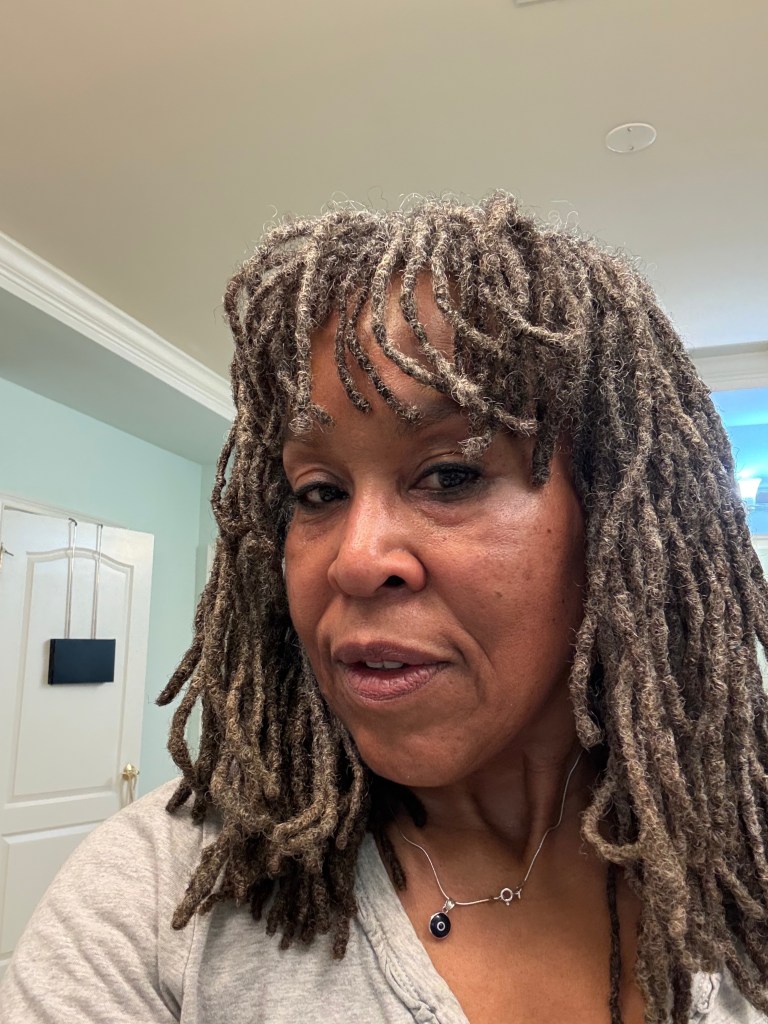
The weather has been very cold and windy due in part to the polar vortex that seems to dip down from Canada more often than in years past. What I have done with my loc maintenance this winter has been really a game changer. Let’s call it my Canadian vortex loc response. Surprisingly, it has been a very easy routine to follow. My locs have grown and now sit thickly on my shoulders. I have gotten used to the warmth on my neck and the way my hair curls inside of my collars and turtleneck sweaters. Having my locs feel moisturized and soft against my neck has made the cold winds tolerable.
Winter Loc Maintenance Routine
I continue to wash my hair once a week. Depending on my daily schedule, wash day is either Friday, Saturday or Sunday. No stress there.
I usually apply Dr. Bronner’s diluted castile soap with a spray bottle in the shower. Usually, I will follow with a second lathering of hydrating shampoo by Cecred. During this winter I decided to combat dryness in my locs with conditioner after the shampoo. I have been using Cecred’s moisturizing conditioner.
I finish my shower then, rinse the conditioner thoroughly and squeeze the water from my hair. I do not wring the water from my hair. Twisting the locs together while wet causes loose wet hair to migrate into neighboring locs. Its much better to just grab sections of hair and squeeze the water out from root to loc tips.
I wrap my hair with a microfiber towel. While I dry off, the towel has time to absorb some excess water. At almost three years loc’d, it now takes two hours for my hair to fully dry. I don’t mind. While I am waiting, I will run my fingers through my locs to separate them. I take time to wrap loose strands of hair around the appropriate locs. I move my locs into the style of the day. My last wash day task is to apply oil. I don’t always apply oil immediately after shampooing my locs. Most weeks I wait until the next day and apply aoil after I have sprayed my locs.
There are a few oils I am currently using. I have my staple Black Jamaican Castor Oil, Cecred Hair Oil, a blend of oils I bought on vacation in St. Martin and a mixture of oils I concocted by blending Argan oil, rosemary and amla oil with a little teatree oil and peppermint essential oil. I do not use all of these oils together -simultaneously. I will apply a small amount of one or two oils in the palm of my hand and use my finger tips to apply in several areas around my temples and scalp. Most of this oil will go to the length of my locs to help keep moisture in. I will not apply oil again until after my next shampoo.
Using less oil allows my own sebum to do its job and I have had no dandruff since locking my hair. I had a lot of itching during my first 4 months wearing baby locs but I stopped applying oil for a month as an experiment and the itching stopped. Since this revelation, I use oils sparingly on my scalp and locs.
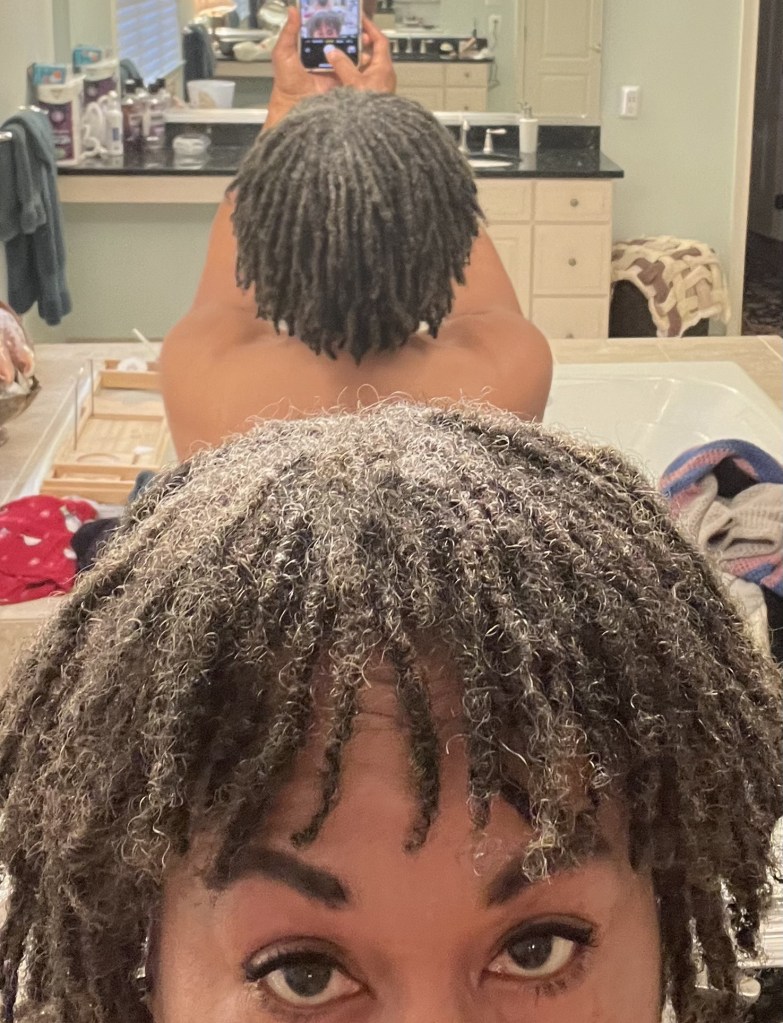
The biggest difference this winter is I am spraying my locs with water twice a day and using instant conditioner after I shampoo. This winter my locs have felt supple. They have also continued to grow. My first two winters as a loc wearer I noticed my hair growth slowed during the winter. I expected this. My loose natural hair would also stop growing during the winter… or so I thought. I am taking the same vitamins and supplements as the last two winters and yet this winter my locs have continued to grow. I can tell there is growth becuase I see the new growth at the roots but due to the shrinkage I don’t see longer locs until I retighten them. This year I will let my locs tell me when they need to be retightened.
Steam Your Locs
For Christmas my daughter gave me a steamer. I have used it four times since then; so, every two to three weeks. I used it first with only water on my locs. Next, I applied a leave in conditioner. Finally, I applied the conditioner in the shower and used the steamer with a goal of seeing what changes if any were apparent. The steamer softened my locs with just water. My locs felt supple for the rest of the day. I did not reapply water during the day. When I applied leave in conditioner I did not notice any difference from applying just distilled water. When I used the steamer after applying conditioner in the shower my locs were supple for two days. I did spray water on my locs the next morning but I could have gone without. My experiment with a steamer shows me that a steamer is a good tool to use on my locs at least during the winter. The steamer does help keep my locs supple and moisturized.
The Knotted Locs Experiment
If you recall, at the end of August 2024, I installed 10 (ten) knots at the base of what I felt to be thinner locs. I had not retied or interlocked my hair in more than 3 months in keeping with Melissa Blake’s Knotted Locs. During the first night I removed 7 of the knots. They were too close to my scalp and caused too much tension, In other words, I felt they were too tight. I left 3 knots in and they remain in place to this day.
My observations have been: tThe knotted locs experienced less slippage. I did not have to retie the knotted locs when all of the other locs were retightened. As time passed the new growth between the knot and the scalp had very few loose strands. In February, when I retightened my locs I was able to use my interlocking tool and interlock the three knotted locs. That was six months after the knots were installed. I can still feel where the knots are on each loc. Due to there being only 3 of them there is no real change in the way my locs look.
I am finally beginning to embrace interlocking as the loc maintence method I want to use on my hair. From around six months on this journey I have been afraid that interlocking is stressful on the roots and scalp. I now think that infrequent reties without trying to catch every millimeter of new growth are a healthy way to maintain my locs. Also, retying or palm rolling locs is fine for me for maintenance between retightenings, because I wash my hair once a week, retwisting my locs doesn’t last very long. Sometimes I am happy with just separating my locs after a shampoo.
Wearing Bangs or A Fringe
I have followed the loc trimming instructions Pauline Walker, En Toi Beauty gave earlier in December 2024 on her YouTube channel to trim your locs. I don’t know if I can describe the technique here as well as she demonstrates. Basically, you determine where you want your locs to stop and where you want the bangs to start. Comb the locs forward that will make up your bangs. Going from the top of your head to the bottom of your bangs pick up one row of locs. Cut the lowest one so it ends where you want your bangs to stop. The loc immediately on top of this one is cut next. It is cut slightly shorter than the lowest loc. Make sure each cut is made at an angle, not straight across. Continue to cut each loc in this row making sure the top one is a little shorter than the one before. Then go to the next row and cut those locs the same. When you have finished cutting you need to go back to each loc, spray water and palm roll the loc to close the end and keep hairs from escaping and making a ball at the end of each loc. This advice was given to me by Lillian Okibe.
After I used this technique to trim my bangs, I parted sections down the side of my face and trimmed those locs as well.
If you have not signed up for the Lilian Okibe Locks course, I highly recommend it. The cost is $59.99 US Dollars. Currently, you will have one year’s access to the course at that price. As a bonus, Lilian Okibe adds modules to her course and you will have access to the new information as it rolls out. I was recently made aware there is a loc cutting tutorial in the course. After reviewing that section, I picked up my shears and cut my bangs a second time. Please note that my bangs had been trimmed 6 to 8 weeks previously and I had no need to cut the locs framing my face. Lilian Okibe’s cutting instructions are similar to Pauline Walker’s. Since they are both trained hair stylists that should be no surprise. Ms. Okibe’s focus however is to keep your locs looking fuller after your cut. Ms. Walker’s focus is to cut the locs in a style. Both work!

Really excited to be approaching three years on this microloc journey!
Any thoughts or concerns about trimming your locs? What is the worst thing that might happen? Please note that I am only asking about trimming not cutting off locs. In fact, I hope you
Stay loc’d!
Bettye
Microlocs and Me: A Woman’s Loc Journey
I am thirteen months into my loc journey and I am obsessed with my hair. As a black woman in America in 2023 I think that is making a strong positive statement. I had the idea of writing a blog within days of starting my loc journey simply because the novelty of being in love with my hair was completely new to me. I was excited to share this process so that more people, …well, yes, more women of color… would try locking their hair and consequently fall in love, too. Like religion, when you find a good thing you just want to share it with anyone who will listen.
I am noticing there are more women on newscasts with dreadlocks or locs. I believe this is progress. Seeing a hairstyle on television helps make that hairstyle more accepted in the general public. It is becoming more common to see a black actor or actress with braids, natural hair and occasionally locs. On East New York (CBS) a few weeks ago there was a mother of a murder victim with locs. The actress wore her hair pulled into a ponytail at the base of her neck throughout the episode but she had locs.
It is still a worthy effort to normalize locs currently.
Semi Freeforming
I mentioned that I was engaging in an experment – the semi freeforming experiment. In this experiment, you stop interlocking and retwisting your hair as a means of maintaining your locs. Several YouTube loc ladies are semi freeforming – Holistic Flo, Amber Loryn and LaurenNicole are three whom I follow and recommend. Note that these ladies do not have microclocs. They do however describe their own loc journey maintaining locks with minimal loc manipulation. Based on their channels, I believe they do not retwist their locs every one to two months. I believe their maintenance is more separating their locs every three to six months.
The one thing I have noticed consistently is that there are no hard fast rules for semi freeforming. The only requirement seems to be allowing your locs to form on their own with manipulation as needed to keep your locs from joining together. Even in this loose context there was a lot for me to consider. I have mentioned that I did not understand how twisting your hair would cause it to loc. I knew the hair on my crown would unravel. The curl pattern is looser there. I thought the hair in the back of my head would lock easily. My sister had joked when I began my journey saying that my hair would lock in 3 months. I thought that would be three months of me re twisting loc after loc; so, I decided I would maintain my locs by interlocking.
I interlocked each of my baby locs at about one and a half weeks because I was already seeing unraveling and I did not want to have to re-establish my foundation grid. I interlocked again at 4 weeks. This time in order to get 2 rotations in each loc I ended up interlocking my hair close to my scalp. My scalp did not appreciate it. The tension from my tightened locs irritated me and my scalp ached for about a week. I promised my self I would never retighten my locs so close to the scalp again.
About this time on my loc journey I discovered Yannie, the Locologist on YouTube. Yannie has a well deserved reputation and following on YouTube. She typically posts videos about mistakes people have made with their locs and better still, she gives advice on how to combat the problem. One of Yannie’s truisms is don’t retwist or interlock your hair every 4 weeks. She brings the message home by showing how people have damaged their locs by retightening or retwisting too often. Some of her clients only get their hair retwisted every 6 months. Since I love to run water through my locs when I shower, retwisting is not a long term maintenance option for me. I will retwist with water if I have hair growing away from my locs and I am not ready to interlock. I see now how retwisting encourages the loc to grow in coils.
Spraying my locs with water helped relieve some of the tightness. I believe it helped because the heavier, wet locs pulled away from my scalp just a little. During this time I would spray my scalp with water and then apply oils to my scalp almost every day.
I did better with my retie at 8 weeks. My retie at 12 weeks was a bit of a fiasco. I managed to tie one lock in with another loc. It was very difficult getting my loc unconnected. In frustration I used scissors to cut a few strands. Months later these strands would refuse to join a loc and several times the strands were braided into the correct loc. At one year loc’d those strands were braided and interlocked (for the umpteenth time) into the right loc and it seems that finally this is where they will stay.
Pauline, the YouTube loctitian behind En Toi Beauty, has said that if you have Sisterlocks or Microlocs you are not a good candidate for semi freeform locs. My locs are pretty chunky for microlocs; so, I thought I would prove her wrong or at least test her theory. At 7 months loc’d most of my hair decided to grow into the locs. There were plenty on the top of my head and on the sides that had not committed despite having been interlocked. In November of 2022 I decided not to interlock any more and see if my hair would lock while staying separated. I have loved the feel of my locs since day one. Everyday, I run my fingers through my locs and feel the base of each one to make sure there is no marrying. When I found locs tangling together, I would very carefully pull the hair strands out of the wrong loc, I do not pop my locks because I would rather not have to weave in the broken hair ends as the strands grow longer. When I have come across strands of hair that have come out of the loc or grown our of the loc, I split the errant strands into 2 sections and braid them with the loc.
In February 2023, I panicked. There were about 8 locs with hair growing outside of the locs. There was a lot of new growth and I had continued to run water through my hair while I showered. No braiding. No banding. My routine is simple.I separate my locs under running water, squeeze out the excess water after my shower and dry my locs with a microfiber towel.
I decided to pivot. Did I mention that locs are very freeing? Locs are very forgiving and they will let you pivot. I chose to interlock my hair instead of continuing on my semi freeforming journey at that time. It occurred to me that my locs had changed in ways I had not anticipated so perhaps I would have a freeforming journey later.
I notice that my locs in the back have not locked in 3 months of low manipulation. I decided to see how long I could let my locs go between retightenings. In February I interlocked my entire head. Two months later in April I interlocked the crown and the sides only. The locs in the back were doing fine. None were trying to marry a neighbor and all of the hair was growing inside the locs. So, the experiment continues.
Currently, I am enjoying the frizzy roots in between retightenings.

Microlocs: the Basics
It is the most simple thing in the world really. Coilly, curly hair will curl on itself. The tangles my mother combed out of my coilly, curly hair every month until I was twelve are a testament to this. At age 12, I graduated to having my hair permed to make it more manageable. I imagine a lot of women can identify with this ritual. I left my hair permed for the next decade except for a brief period when I got a hair cut in Denmark and the stylist gave me a fade. Not the look I was going for but I wore my hair short and natural for a year before I went back to perming my hair.
In December of 2012, I decided I had had enough. My hair would not grow past a certain length because I always had breakage or split ends or some type of damage. I felt like a failure and I felt like my hair was a failure. I decided to go natural. I decided I would grow a thick afro that would sit on my shoulders. Occasionally, I would twist it and have waves of curly hair. Much to my surprise, that never did happen.
My daughter decided to go natural, too. She was in college, not far away. We shared notes and made comparisons. She was more adventurous. She made wigs, wore wigs, added extensions, colored her hair. I too colored my hair. I used henna to cover the grey and white hair that peaked out every month. I loved my natural hair. I learned a lot about it. I learned that all of my hair is not 4C, There are some looser 4B curls in different sections. I learned that my hair loves Jamaican black castor oil. I had a shelf in my closet just for my hair care products my hair didn’t like as much. I was the poster child for the slogan: “My Hair is My Hobby”.
Sometime in 2016, my daughter had Sisterlocs installed. She cut her hair to reduce her cost of installation. I couldn’t imagine spending a thousand dollars for a hairstyle. I was perplexed, stymied, not convinced that this was a good decision. She tried to convince me to loc my hair with her. My husband was just as insistent that I did not. So, it was very easy not to loc my hair. But, my curiosity was piqued.
As time passed, my daughter’s locs grew and grew. They are now mid back length and very beautiful. It was Christmas of 2021 when my daughter came home for the holidays, when I knew for certain I had to start my loc journey. It did not matter that my husband’s opinion had not changed. After 35 years of marriage, I felt pretty sure a hairstyle change would not be a big issue. What drove my decision more than anything was the thought that I didn’t want to leave earth, that is – die, without ever having had long hair.
All of the old concerns about locs being unwashed, uncared for hair had been swept away by my very thorough research at YouTube University and vicariously through my daughter’s lived experience. I knew that whether I chose to wash my hair once a month or once a week was a decision for me to make. How I would maintain my locs would be my choice. I set out to find a loctitian.
I had reached out to a friend’s loctitian in 2019 for a consultation. She was not taking on any new clients. In December of 2021, I reached out to another local loctitian. She replied in November of 2022 that I should call to get on her schedule. By that time, I had already installed my locs and I was seven months into my loc journey.

In January of 2022, I installed two strand twists to see if I would easily get bored of wearing my hair in the same style. I have friends who have worn their hair in the same style for years. While none of these friends are black, I thought perhaps I could try to adopt their approach. Clearly, a one month trial was in order. Usually, Sisterloc consultants install a few “test” Sisterlocs for clients to see if this is a style they will enjoy. Anyway, it seemed like a good idea.
I had not been much of a 2 strand twist wearer. Twists for me were typically a means to getting curly or stretched hair. It turned out I enjoyed the way my two strand twists looked. It did not bother me that they did not look like locs. It was enough to get an idea what living with locs might be like.
January’s experiment went well. In February, I took down the twists; washed and hennaed my hair and re-installed two strand twists. It occurred to me, “why not just install two strand twists in your hair each month?” In March, I noticed that as I took down my twists, conditioned, detangled, washed, hennaed, conditioned, and oiled my scalp and hair before installing two strand twists again that the effort was taking about as much time as wash day with loose natural hair. It also occurred to me the detangling process would at least be eliminated if I left my hair in two strand twists. As I write, I now know combing, parting and detangling two strand twists keeps the hair strands from matting together to become locs. In March I decided this time I am going to install two strand twists and officially start my locs. Making the mental declaration is the first step.
Over the course of one day I installed 96 two strand twist baby locs on my hair. I felt pretty accomplished. I told my daughter. She was happy for me and proud I had finally taken this step and loc’d my hair. She was also surprised I had actually done it and, I found out later, she told her old college roommate she wasn’t sure how long I would keep them. Meanwhile, I liked getting up in the morning and not having to stress over what was I going to do with my hair today. The feeling of freedom for me was almost instantaneous. That was March 26, 2022.
I was sure I had done the right thing locking my hair. But, I was afraid I had not given myself enough locs to satisfy my desire to have loc style flexibility.I Sprayed my locs with my new mister spray bottle and divided each loc into two or more sections. This dividing took place over two days. On April 2, 2022, I declared my microlocs installed. I had 212 locs. In 3 months time this number would shrink to 210 microlocs as I combined 4 locs into 2. I had thought if I have 200 or so microlocs and I decide I want more traditional sized locs, I can simply combine some together.

I Know What I Know
I had done my research. I knew I was supposed to keep my locs moisturized by spraying daily with water, or rose water, or aloe vera gel. (Over time I have refined what goes into my moisturizing spray bottle.)
I knew I wasn’t supposed to wash my locs for 4 weeks. Some people seem shocked to hear this ; but, as a loose natural, it was common for me to wash my hair once a month. I was more surprised by the YouTubers who washed their locs within the first month. Today, I’m pretty sure you do not have to wait 4 weeks to wash your hair…especially if you interlock to maintain your locs. Even if you started your locs with finger coils there are ways to wash your hair. You can braid and band your locs.
I knew about braiding and banding my locs if, and when, I was going to wash them. One big surprise was my locs had shrunken so much after the daily misting moisturizing I did not have enough hair to braid. So, if your locs are short, you just band your locs together before washing. At one year loc’d, I can now braid and band. But, I’m getting ahead of myself.
I now know that when you wash your locs for the first time should not be dependent upon some arbitrary date. The need to shampoo your hair is particular to your scalp and locs’ requirements. You should feel free to wash or my favorite, rinse your locs when they need it.
I knew to use a clear shampoo and not creamy detangling shampoos or conditioners. I was ready for the first wash with Dr. Bronner’s Castle soap in Peppermint. I have since bought Dr. Bronner’s Shampoo in Rose and in Eucalyptus. These are the only shampoos I have used with the exception of a conditioning shampoo by Giogio Di Acqua I used while on vacation. My daughter had used it on her locs and was pleased with the conditioning. In my defence, the product is mostly clear, certainly not creamy and I forgot that she has been loc’d about 7 years while I was only 3 months loc’d. Her mature locs enjoyed the conditioner. I, on the other hand, could feel the coating of conditioner on my locs even after I rinsed my locs three times. As my locs dried, I noticed a lot of strands slipped out of my 4B locs. If you have a looser curl pattern, I recommend that you do not use conditioner on your locs during the first year.
The use of conditioner in locs is one of those “Hot Button Topics”. If you use conditioner on your locs, how long have you been loc’d and when did you start using conditioner? How do you use conditioner?
I am curious as to how you use conditioner because while I do not use it, I also do not use shampoo the same way I did as a loose natural. I now put my shampoo in a spray bottle and dilute the shampoo with water. Dr. Bronner’s Shampoo is a concentrate which has to be mixed with water. I dilute a little more than specified. Spraying the shampoo places it directly on the scalp. I use the balls (tips, pads) of my fingers to massage the shampoo into a lather. I rinse this out and reapply shampoo. Again, I focus my attention on the roots and the scalp. I then squeeze soap through the length of my locs. I rinse them several times with warm water until no soap washes out of the locs.
One of the freedoms microlocs has given me is the freedom to wash my hair in the shower. Let me expand on that. For the first time in my life I have the freedom to just let water run through my locs every time I get into the shower. I no longer worry if, and when, my hair gets wet.
I used to wash my loose natural hair in the kitchen sink because I hate hair from my head getting stuck on my body. To my very pleasant surprise, I don’t mind washing my hair in the shower because loc’d hair sheds only a very little bit. If you’re not looking for it, you will likely miss, or maybe not miss, the shed hairs.
I knew I needed to use a microfiber towel to dry my hair. Some YouTube loc stars only use a teeshirt. I have never tried that. I bought extra large grey microfiber towels from Amazon. I love them. They leave no lint and they dry my locs pretty quickly. Once towel dried, damp locs are easy to style. Again the joke was on me. 210 microlocs and I usually just “play the harp” while running my fingers through my hair until my locs are shaped the way I want them to be for the day. To “play a harP’ one curls ones fingers and gently plucksat each individual harp string. In this analogy, your microlocs are the harp strings. I find myself “playing the harp” through my locs several times a day. I know the conventional wisdom is to keep your hands out of your hair. I really love the feel of my locs so much I thank God for bringing me to this new state of being where I truly love my hair and all of the weird things it does. So thankful for having installed my microlocs.

For 12 years, I had been a “loose natural” (loc terminology to describe someone with natural hair that is not loc’d). So, I knew about hair shrinkage. Shrinkage comes with the territory when you have 4C and 4B textured hair. Even with this knowledge, I was surprised that my hair went from longish 2 strand twists to skull hugging baby locs.
I knew that I needed a silk or satin bonnet or scarf to tie up my locs at night to keep them from having all the moisture sucked out of them by cotton sheets; as well as, to protect my locs from lint. A satin or silk pillowcase would not have been effective for me. I enjoy pulling the covers over my head when I sleep. As a loose natural, I already had a collection of satin like bonnets. As a sewer, I decided to cut up a satin pillowcase to make a bonnet for sleeping. This is my favorite bonnet. I toss it in the wash once a week.
Why Microlocs?
As you may have noticed, I started my loc journey with 96 locs . I then started second guessing my decision. I went back to YouTube University. It began to become obvious, the more locs I had, the more opportunities I would have for styling my hair and hopefully, there would be fewer reasons to become bored and cut off my locs. I thought about the versatility my daughter has with 700 Sisterlocs. I knew, however I did not want to maintain 700 locs. But, I could maintain 200 locs. I went to work untwisting and retwisting my locs. Two strand twist microlocs gave me the flexibility to change my mind about the number of my locs.
I have always been sensitive about my forehead. My edges have always been sensitive to tugging and friction. I decided that I would make my locs extend down from the crown of my head towards my face and neck. I did not want a scalpy look. Sharp, crisp, well defined parts or a grid were not on my list of “must haves” for my locs. Microlocs gave me the ability to have fringe bangs that stayed on my forehead for the first time ever! Microlocs allowed me to protect the delicate hair around my temples and hair line edges. The general shape of my hair with microlocs was pleasing to me.
With microlocs, when you are styling your locs, it is the shape of the hair around the face that matters. This is especially true with short microlocs. I used my fingers to guide my locs into the pattern or shape I wanted them to assume while they were damp following my morning misting spray. Typically, I did not have to think about my locs again until it was time to wrap them up at night to go to bed.
I installed my locs on a brick pattern, more or less. There are definitely horizontal lines across the back of my head from the nape of the neck up to the occipital line – which I interpret on my head as just above the ears. The section above the ears moving to the crown of my head has a few locs that have a diagonal edge. Not my best decision. I believe installing an all over diamond grid relies on larger partings. With my smaller partings, I have occasionally interlocked these angled edges with the wrong loc. Based on my experience, I recommend you stick with a square shaped loc base or rectangular for microloc installation. Let me know if you have a different take on the shape of the base of the loc. Two strand twist microlocs were easy for me to determine the size and shape and location of each of my locs.
At the top of my head, I wanted to have the flexibility to style my locs with a center part as well as a part on either side. I was careful to install my top and front locs after these partings were made. I did not intend to part my hair exactly down the center in the back. If I want to wear pigtails I will have an uneven line down the back of my head. I thought that was less of a problem than not having full coverage of my scalp in the back. The offset brick pattern I used insures fullest coverage possible of the scalp. Not breaking that pattern with a straight line was a design choice I made. Thus far, it has not been a problem.

The biggest joke I think is this: most of the time since installing my microlocs in April of 2022, I have worn my locs without imposing any style on them. With microlocs, especially when they are short, it’s about the health and shape of your hair. If your locs are healthy, they are going to look good. One morning while walking in the park, I started a conversation with a woman whose behavior interested me. Turns out she was very receptive to electricity in the air. As she finished explaining her actions, she said, “You take really good care of your hair.” I took that as a compliment. My baby locs had been sprayed and they were luscious. I know that some mornings the sun strikes my gray hair and makes it look like a halo.
This post got a little lengthy. In my next post I want to share some of the issues I have dealt with as a new traveler on this loc journey. Itchy scalp was a particular problem.
What types of issues have you encountered on your loc journey?
Wishing you peace and hair freedom,
Bettye